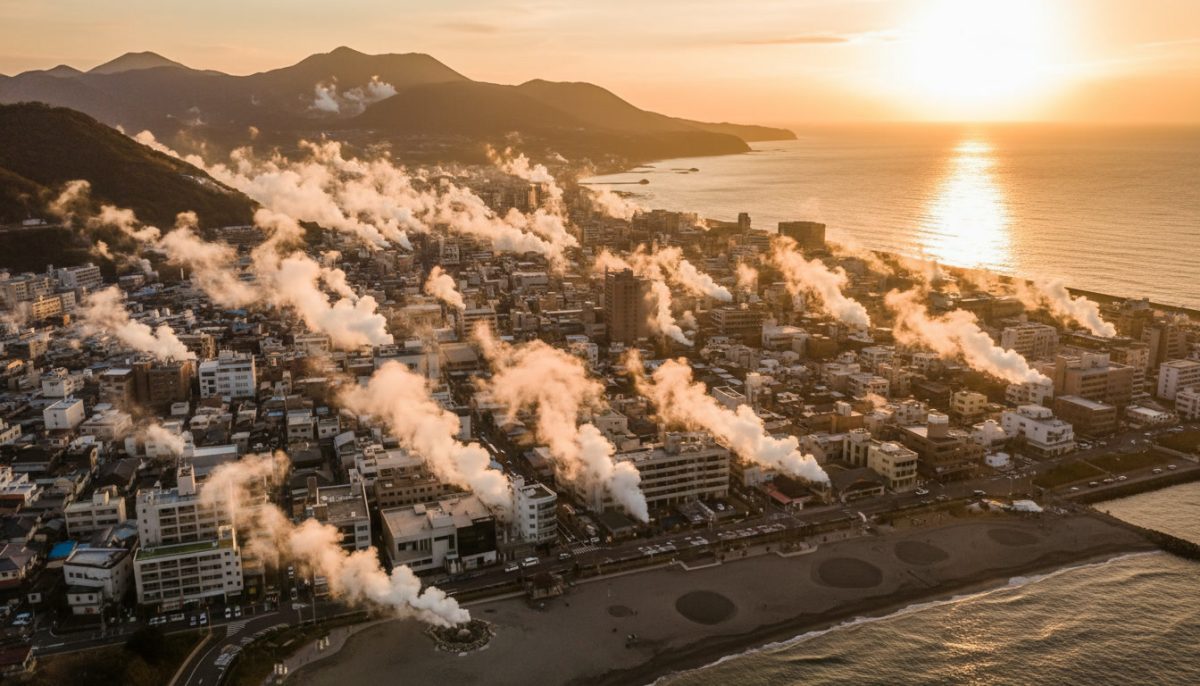


Every city in Japan has restaurants. A few have castles. Beppu has the earth itself, venting hot water and steam from seemingly every surface.
Beppu (別府) in Oita Prefecture is the largest hot spring city in Japan. It produces more geothermal water per day than any other city on the planet. The steam is visible from the highway as you approach — columns of white rising from between apartment buildings, parking lots, and shopping streets, as if the city were gently simmering.
Most onsen towns offer one type of bathing experience. Beppu offers everything: sand baths, mud baths, steam baths, conventional soaking baths in a dozen different mineral compositions, and outdoor pools overlooking the Pacific Ocean. It is not a hidden gem. It is an open secret that rewards visitors who look beyond the famous “hells” and into the neighborhoods where locals have been bathing for generations.
Beppu Hatto: Eight Districts, Eight Characters
Beppu’s hot springs are organized into eight districts, collectively called Beppu Hatto (別府八湯). Each district has its own history, water source, and atmosphere.
Beppu Onsen (別府温泉)
The central district, closest to the train station. Home to Takegawara Onsen, a sand bath facility housed in a wooden building that has operated since 1879. This is the most accessible district for visitors arriving by train.
Kannawa Onsen (鉄輪温泉)
The most atmospheric district. Narrow streets wind between ryokan and public bathhouses, with steam escaping from every drain and vent. The air smells of sulfur. Kannawa is where you find jigoku-mushi (地獄蒸し) — cooking food in volcanic steam — and some of the city’s best traditional bathhouses.
Myoban Onsen (明礬温泉)
A hillside district famous for its sulfur deposits. Thatched-roof huts called yunohana goya are used to collect crystallized minerals from the steam, a practice that has been designated an Important Intangible Folk Cultural Property. The mud bath at Beppu Onsen Hoyoland is in this district.
Hamawaki Onsen (浜脇温泉)
The oldest district, with hot springs documented for over a thousand years. Less touristy than Kannawa, more residential. The public bathhouses here are used primarily by locals and cost as little as ¥100.
Kamegawa, Shibaseki, Horita, Kankaiji
The remaining four districts are primarily residential, with small local bathhouses that rarely appear in guidebooks. For visitors willing to explore beyond the main three districts, these neighborhoods offer an authentic look at how Beppu residents actually use their hot springs — as a daily routine, not a special occasion.
Experiences You Cannot Find Anywhere Else
Sand Bathing (砂湯, Sunayu)
At Takegawara Onsen in central Beppu and at Beppu Beach Sand Bath along the coast, you lie on naturally heated volcanic sand while attendants bury you up to your neck. The weight and warmth of the sand create a sensation unlike anything else — a full-body compression combined with radiant geothermal heat.
Sessions typically last 10–15 minutes. Afterward, you rinse off in a conventional bath. The experience is said to improve circulation and relieve muscle tension. Whether or not you believe the health claims, the physical sensation is genuinely unique.
Takegawara: Indoor sand bath in a historic wooden building. ¥1,500. No reservation needed. Beach Sand Bath: Outdoor, beside the ocean. ¥1,500. Seasonal availability — check current operating months.
Mud Bathing (泥湯, Doroyu)
Beppu Onsen Hoyoland in the Myoban district offers bathing in warm, mineral-rich mud. You lower yourself into a pool of gray-brown mud the consistency of thin yogurt, and coat your skin. The mud contains sulfur and other minerals that leave your skin feeling unusually smooth after rinsing.
The facility is basic — concrete pools, outdoor setting, minimal amenities. The experience is earthy in every sense of the word. Mixed bathing is available (with separate areas for those who prefer gender-segregated bathing).
Admission: ¥1,100. Cash only.
Steam Cooking (地獄蒸し, Jigoku-Mushi)
In the Kannawa district, Jigoku Mushi Kobo provides a public steam cooking facility where you place food — vegetables, eggs, seafood, meat — into stone chambers vented with volcanic steam. The food cooks in minutes, infused with a subtle mineral flavor.
You purchase ingredients at the facility or bring your own. A tray of mixed vegetables and eggs costs approximately ¥500–¥1,000 in ingredients, plus a facility fee of ¥500–¥700 for use of the steam chambers.
This is not a tourist gimmick. Kannawa residents have cooked this way for centuries. The method is fast, requires no fuel, and produces food that tastes distinctly different from conventional steaming.
Steam Baths (蒸し湯, Mushiyu)
At Kannawa Mushiyu, you lie on a floor of medicinal herbs inside a stone room filled with volcanic steam. The temperature is high — around 65–70°C — and sessions are limited to approximately 8 minutes. The combination of heat, humidity, and herbal fragrance is intense and deeply relaxing.
Admission: ¥510. Bring your own towel or rent one.
The Jigoku (Hells)
Beppu’s most famous tourist attraction is the Jigoku Meguri (地獄めぐり) — a circuit of seven geothermal features that are too hot, too acidic, or too violent for bathing. They are viewed, not entered.
The hells include boiling blue pools, churning mud ponds, and a geyser that erupts approximately every 30 minutes. A combined ticket covers all seven for ¥2,200.
The hells are visually impressive but heavily touristed. If your time in Beppu is limited, the bathing experiences described above offer more depth and less crowding. Visit the hells if you have a full day; skip them if you have only an afternoon and would rather spend it in the water.
Tattoo Policy
Beppu is one of the most tattoo-tolerant onsen cities in Japan. Many bathhouses — including some public facilities — welcome tattooed visitors. The city’s long history of accommodating international tourists, particularly from South Korea and other Asian countries, has created a more flexible atmosphere than you will find in the Kanto or Kansai regions.
That said, individual policies vary. Large facilities like Suginoi Hotel’s rooftop bath enforce restrictions. Smaller neighborhood bathhouses (public sento costing ¥100–¥300) generally do not check. The sand bath and mud bath facilities are typically accepting.
When in doubt, ask at the front desk before entering.
Getting There
From Fukuoka: JR Sonic limited express from Hakata Station (approximately 2 hours). Frequent service throughout the day.
From Oita Airport: Bus to Beppu Station (approximately 45 minutes).
From Yufuin: JR local train (approximately 1 hour) or bus (approximately 50 minutes). Combining Yufuin and Beppu is a natural two-to-three-day itinerary.
Within Beppu: Local buses connect the main districts. Renting a bicycle is practical for covering the central and Kannawa areas. Taxis are affordable for reaching Myoban and other hillside districts.
Where to Stay
Beppu offers the full range of accommodation, from ¥3,000 guesthouses to ¥50,000 luxury ryokan.
For the Kannawa experience: Stay at a ryokan in the Kannawa district. Several offer rooms with private steam vents for in-room cooking, plus access to neighborhood bathhouses.
For beach and sand bathing: Hotels along the coast near Beppu Station combine ocean views with proximity to Takegawara and the beach sand bath.
Budget option: Beppu has a healthy backpacker scene. Guesthouses near the station offer dormitory beds from ¥3,000 and can direct you to the best local bathhouses.
Practical Tips
- Beppu is a city, not a village. Expect urban infrastructure: convenience stores, restaurants, taxis, and cell service everywhere.
- ¥100 public baths exist throughout the residential districts. Bring your own soap and towel. These are local, no-frills facilities — and some of the best bathing experiences in the city.
- Budget a full day minimum. Beppu’s variety demands time. Sand bath in the morning, jigoku-mushi lunch in Kannawa, mud bath in the afternoon, conventional onsen in the evening — this is a realistic one-day circuit.
- Steam vents are real hazards. Some sidewalks and park areas have natural steam vents at ground level. Watch where you step, and keep children close.
- Combine with Kurokawa or Yufuin for contrasting experiences: Beppu’s urban energy versus Kurokawa’s forest silence or Yufuin’s artistic village atmosphere.
FAQ
How many days do I need in Beppu? One full day covers the highlights. Two days allow you to explore the residential bathhouses and the less-visited districts. Three days let you do everything at a relaxed pace, including a day trip to Yufuin.
Is Beppu good for families? Yes. The sand baths, steam cooking, and jigoku hells are all engaging for children. Many facilities welcome families, and the city’s infrastructure makes logistics easy.
How does Beppu compare to other onsen towns? Beppu is the opposite of a quiet hitō experience. It is vibrant, diverse, and urban. If you want silence and nature, go to Nyuto or Kurokawa. If you want variety and adventure, go to Beppu. The ideal Kyushu trip includes both.
Beppu is featured in our regional guide and tattoo-friendly guide. For Kyushu itinerary ideas, combine with our Kurokawa Onsen guide.