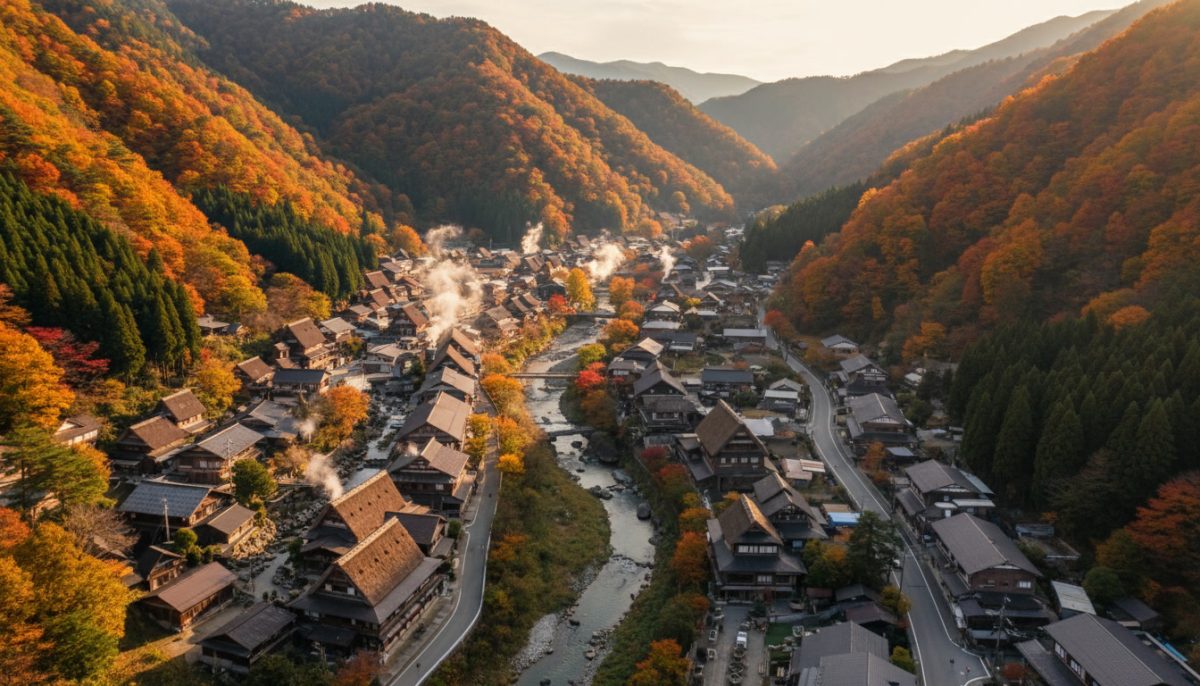


Every “best onsen in Japan” list includes the same five names: Hakone, Kusatsu, Beppu, Arima, Noboribetsu. They are famous for good reasons. They are also crowded for those same reasons.
This guide takes a different approach. Instead of ranking individual onsen, it maps Japan’s hot spring landscape region by region — from the volcanic north of Hokkaido to the subtropical south of Kyushu — and highlights the places where the water is excellent, the atmosphere is calm, and the tour buses have not yet arrived.
If you have already visited the well-known names, this is your next step. If you have not, consider starting here instead.
How to Use This Guide
Japan has over 27,000 hot spring sources and more than 3,000 onsen resort areas. No single article can cover them all. What this guide offers is a curated starting point for each major region, chosen according to three criteria:
- Water quality — interesting mineral composition, high natural flow rate, or a distinctive sensory experience (color, smell, texture)
- Atmosphere — small scale, low commercialization, natural surroundings
- Accessibility for international visitors — reachable by public transport (even if it takes effort), with at least some English-language information available
Prices, access details, and seasonal notes are included where they are stable enough to be useful. For anything that changes frequently — exact bus schedules, current room rates — we recommend confirming directly with the facility or the local tourism board.
Hokkaido: Where the Land Still Steams
Hokkaido is Japan’s northernmost main island, and its volcanic geology produces some of the country’s most dramatic hot springs. The landscape is bigger, wilder, and less developed than the rest of Japan. Onsen here tend to feel like they belong to the earth rather than to a town.
Tokachidake Onsen (十勝岳温泉) — Kamifurano
At 1,280 meters above sea level, Tokachidake is one of the highest-altitude onsen in Hokkaido. The baths look out over the Tokachi mountain range, and on clear days the view extends to the horizon in every direction. The water is acidic and iron-rich, with a distinctive reddish-brown color that stains towels permanently.
There are only a handful of inns at this elevation. The road is closed by snow from late November through mid-May, which means that summer and early autumn visitors share the mountain with almost no one.
Best for: Hikers, photographers, anyone who wants an onsen experience that feels genuinely remote.
Nukabiragai Onsen (糠平温泉) — Kamishihoro
A small cluster of inns beside Lake Nukabira in the Daisetsuzan National Park. The town has a population measured in dozens, not thousands. In winter, the frozen lake hosts the famous Taushubetsu Bridge — a concrete arch bridge that appears and disappears with the water level throughout the year.
The water is simple thermal (sodium hydrogen carbonate), clear and gentle on the skin. Several inns offer rotenburo overlooking the lake and forest.
Best for: Winter travelers, solitude seekers, visitors to Daisetsuzan who want to end a day of hiking in hot water.
Tohoku: The Heartland of Toji Culture
Tohoku — the six prefectures of northern Honshu — is where onsen culture runs deepest. This is the region where toji (therapeutic hot spring stays) originated as a medical practice, where self-catering inns have operated for centuries, and where the phrase “hidden hot spring” is not marketing language but geographical fact.
Tohoku receives fewer international visitors than any other region of Honshu, which means that its onsen towns have retained a character that busier areas have lost.
Nyuto Onsen (乳頭温泉郷) — Akita Prefecture
A cluster of seven inns at the base of Mount Nyuto, deep in the beech forests of the Towada-Hachimantai National Park. Each inn has its own distinct water source with different mineral compositions — milky white sulfur at one, clear iron-rich water at another, and so on. A pass is available that grants access to all seven inns’ baths.
Tsurunoyu (鶴の湯), the oldest of the seven, is the most photographed onsen in Tohoku. Its outdoor mixed bath, surrounded by snow in winter, has appeared in countless travel publications. The inn dates to the 1600s and maintains a thatched-roof main building that has not fundamentally changed in over three centuries.
Practical note: In winter, the road to Nyuto is accessible but requires caution. Some inns operate a shuttle from the nearest bus stop. Book well in advance for December through February — Tsurunoyu in particular fills up months ahead.
Best for: The definitive Tohoku onsen experience. Pairs well with a visit to Lake Tazawa.
Ginzan Onsen (銀山温泉) — Yamagata Prefecture
A narrow valley lined with three- and four-story wooden ryokan dating from the Taisho era (1912–1926), lit by gas lamps at night. In winter, heavy snow blankets the buildings and the effect is genuinely like stepping into a different century.
Ginzan became internationally famous after appearing in the NHK drama “Oshin” in the 1980s, and its popularity has grown further through social media. It is no longer a secret — but it remains small. The valley is only a few hundred meters long. There are no chain hotels, no convenience stores, no traffic lights.
The water is sodium chloride and sulfate, clear, and moderately hot. Most of the ryokan are small (ten to twenty rooms) and offer the classic ippaku nishoku (one night, two meals) package.
Practical note: Ginzan is reachable by bus from Oishida Station on the Yamagata Shinkansen. The last bus back is early, so an overnight stay is effectively required — which is the right way to experience it anyway.
Best for: Travelers who appreciate architecture and atmosphere. Stunning in any season, but winter is the iconic experience.
Naruko Onsen (鳴子温泉) — Miyagi Prefecture
Naruko is the functional center of Tohoku’s toji tradition. The town has over 400 individual hot spring sources representing seven of Japan’s ten official water types — a diversity unmatched by any comparably sized town in the country.
Several inns in Naruko offer jisui (self-catering) stays at remarkably low prices, continuing a toji tradition that dates back over a thousand years. The town also has a long history of producing kokeshi dolls — simple, cylindrical wooden figures — and several workshops are open to visitors.
Best for: Extended stays, toji culture, travelers interested in traditional crafts. Naruko is also one of the most accessible Tohoku onsen towns, located directly on the JR Rikuu East Line.
Chubu: Mountains, Rivers, and Altitude
The central highlands of Honshu — including the Japanese Alps — contain some of the country’s most elevated and geologically active hot springs. Access often requires mountain driving or extended bus rides, but the reward is water heated by volcanic systems that are still very much alive.
Shirahone Onsen (白骨温泉) — Nagano Prefecture
The name means “white bone,” a reference to the milky white color of the water caused by dissolved calcium and magnesium. Shirahone sits at 1,400 meters in the Northern Alps, reachable by bus from Matsumoto via Norikura Kogen.
The phrase associated with Shirahone is “three days and you won’t catch a cold for three years” (三日入れば三年風邪をひかない). The water is genuinely striking — opaque, with a slightly sweet mineral smell and a silky texture that is noticeably different from clear thermal springs.
Best for: Visitors to the Kamikochi or Norikura areas who want a hot spring experience with genuinely unusual water.
Okuhida Onsengo (奥飛騨温泉郷) — Gifu Prefecture
A collective name for five onsen villages spread along the valleys east of Takayama. Together, they have the highest concentration of rotenburo (outdoor baths) in Japan — more outdoor baths per capita than anywhere else in the country.
The area is fed by the volcanic activity of Mount Yakedake and the Northern Alps, producing a range of water types from simple thermal to sulfur. Several inns offer baths directly beside mountain streams, where the sound of rushing water mixes with steam.
Best for: Rotenburo enthusiasts. Combines naturally with a visit to Takayama’s old town and the Shin-Hotaka Ropeway.
Kansai: Pilgrimage, History, and Quiet Valleys
The Kansai region is better known for Kyoto’s temples and Osaka’s food than for hot springs, but its onsen culture is ancient and deeply connected to the region’s spiritual landscape.
Yunomine Onsen (湯の峰温泉) — Wakayama Prefecture
Covered in detail in our guide to Hitō and Toji culture, Yunomine deserves mention here as well. Located along the Kumano Kodo pilgrimage route, it is home to Tsuboyu — the only UNESCO World Heritage-listed hot spring in the world where bathing is permitted.
The village is tiny, the water is ancient, and the connection to pilgrimage culture gives the experience a dimension that purely recreational onsen lack.
Best for: Kumano Kodo walkers, travelers interested in the intersection of spirituality and bathing.
Kinosaki Onsen (城崎温泉) — Hyogo Prefecture
Kinosaki is unusual in that the town itself is the experience. Guests at any ryokan receive a pass to visit all seven public bathhouses (sotoyu) in town. The tradition is to wear a yukata and geta (wooden sandals), walk the willow-lined canal, and hop between bathhouses throughout the evening.
Kinosaki is more polished and tourist-oriented than most places in this guide, but it earns its place because the sotoyu-meguri (bathhouse-hopping) tradition is genuinely unique and the town has managed its growth without losing its character.
Best for: First-time onsen visitors who want a welcoming, walkable experience. Excellent as a day trip or overnight from Kyoto or Osaka.
Kyushu: Volcanic Power, Outdoor Bathing, and Sand
Kyushu is the most geologically active of Japan’s main islands, and its hot spring output is extraordinary. Beppu alone produces more hot spring water than any other city on earth. The culture of outdoor and public bathing in Kyushu is relaxed and unpretentious.
Kurokawa Onsen (黒川温泉) — Kumamoto Prefecture
A small onsen town in a forested gorge that has become a model for how a rural hot spring community can thrive without sacrificing authenticity. The town implemented a unified aesthetic policy in the 1990s — no garish signs, no pachinko parlors, no buildings out of scale with the landscape — and the result is a place that feels cohesive and intentional.
Kurokawa’s signature offering is the nyuyoku tegata (入湯手形) — a wooden pass for ¥1,300 that grants access to any three of the town’s roughly thirty ryokan baths. This encourages exploration and makes it easy to sample different water types (sulfur, iron, sodium chloride) in a single visit.
Best for: Travelers who appreciate thoughtful design and community planning. One of the few onsen towns that is both beautiful and affordable.
Beppu (別府) — Oita Prefecture
Beppu is the opposite of a hidden gem. It is the largest hot spring city in Japan, with eight distinct onsen districts (Beppu Hatto) and a daily output of hot water that defies comprehension. But its sheer scale means that even the most well-traveled visitor will find something unfamiliar here.
Beyond the famous “hells” (jigoku, boiling pools for viewing rather than bathing), Beppu offers:
- Sand baths (砂湯, sunayu) at Beppu Beach, where you are buried in naturally heated volcanic sand
- Mud baths (泥湯, doroyu) at Beppu Onsen, where you soak in warm mineral mud
- Steam baths (蒸し湯, mushiyu) at Kannawa, where you lie in a stone room filled with volcanic steam
The variety alone justifies a multi-day stay. Beppu is also one of the most tattoo-tolerant onsen cities in Japan.
Best for: Travelers who want to experience the full spectrum of what Japanese hot spring culture can offer, from ancient to eccentric.
Ibusuki (指宿) — Kagoshima Prefecture
At the southern tip of Kyushu, Ibusuki is famous for one thing: sunamushi (砂蒸し), natural sand bathing. You lie on the beach in a yukata while attendants bury you in sand heated from below by volcanic steam. The weight and warmth of the sand create a sensation unlike any other bathing experience in Japan.
The buried feeling is intense — a combination of gentle pressure and radiating heat that reportedly improves circulation and relieves joint pain. Sessions typically last 10–15 minutes before you dig yourself out (or are dug out by staff) and rinse off in a conventional onsen bath.
Best for: Travelers looking for a completely unique experience. Combines well with a visit to Kagoshima city and the active volcano Sakurajima.
A Note on Timing
The best time to visit any onsen depends on what you want from the experience.
Winter (December–March): The most atmospheric season. Snow-covered outdoor baths are iconic, and the contrast between cold air and hot water is part of the pleasure. But access to mountain onsen can be limited by road closures, and popular destinations book up quickly.
Autumn (October–November): Foliage transforms mountain onsen into something extraordinary. This is peak season at many facilities, so booking early is essential.
Spring (April–May): Mild weather, lighter crowds, and cherry blossoms at lower elevations. An underrated window for onsen travel.
Summer (June–August): Hot and humid at lower elevations, but mountain onsen remain cool and comfortable. Rainy season (late June to mid-July) can affect road access.
FAQ
Which region has the best onsen in Japan? There is no single answer. Tohoku has the deepest toji culture and the most unspoiled atmosphere. Kyushu has the greatest variety of bathing experiences. Hokkaido has the most dramatic landscapes. The best region for you depends on what kind of experience you are looking for.
Can I visit multiple onsen in one trip? Absolutely. Many travelers build itineraries around onsen — for example, combining Ginzan Onsen with Naruko in Tohoku, or Kurokawa with Beppu in Kyushu. The Nyuyoku Tegata pass system in Kurokawa is specifically designed for bathhouse-hopping.
Do I need a car to reach these places? Not always, but it helps in some cases. Ginzan, Kinosaki, and Beppu are reachable by public transport. Nyuto, Tokachidake, and Shirahone are significantly easier with a car, especially in winter.
How much should I budget per night at a ryokan? Standard ippaku nishoku (one night, two meals) at a quality ryokan ranges from ¥10,000 to ¥25,000 per person. Jisui (self-catering) options in Tohoku can be as low as ¥3,000–¥5,000 per night. Luxury ryokan with private in-room baths can exceed ¥50,000.
Are these places suitable for solo travelers? Yes. Solo onsen travel is common in Japan and culturally accepted. Many ryokan offer single-occupancy rates, and the quiet atmosphere of a hitō inn is particularly well-suited to solo visitors.
What is the difference between an onsen town and a single onsen? An onsen town (温泉街, onsen-gai) is a community built around multiple hot spring sources, with several inns, bathhouses, and often shops and restaurants. A single onsen may be a standalone inn with its own private spring. Both offer excellent experiences, but onsen towns allow for exploration and variety within walking distance.
Start With One
The temptation with a guide like this is to plan an ambitious circuit through every region. Resist that temptation. The purpose of onsen travel is to slow down, and you cannot slow down if you are rushing to the next destination.
Choose one region. Choose one or two places within it. Stay longer than you think you need to. The water will still be there tomorrow, and the day after that.
This guide is part of THE Onsen Times’ regional coverage of Japan’s hot spring culture. For cultural context, read Hitō, Toji, and the Quiet Art of Onsen. For practical bathing guidance, see Onsen Etiquette: The Complete Guide.