

Let’s get the fear out of the way first: you are not going to offend anyone.
The internet has turned Japanese onsen etiquette into something that sounds like a minefield — one wrong step and an entire bathhouse of strangers will judge you in disapproving silence. That is not how it works. The rules exist to keep the shared water clean and the atmosphere calm. Follow them, and nobody will give you a second glance. Break one by accident, and the worst that happens is a gentle correction from a fellow bather or a staff member.
This guide covers everything: the sequence of events from the entrance to the exit, the reasons behind each custom, and the honest answers to the questions people are too nervous to ask out loud.
Before You Go: What to Know
What Is an Onsen, Exactly?
An onsen is a bathing facility fed by naturally heated, mineral-rich spring water. By Japanese law, the water must meet specific criteria for temperature (at least 25°C at the source) and mineral content to be called an onsen. This is not a marketing label — it is a legal classification under the Hot Spring Law (温泉法, Onsen-hō), first enacted in 1948.
This matters for your experience because it means the water at a real onsen is not just hot tap water. It contains dissolved minerals — sulfur, iron, sodium, calcium, and others — that affect how the water feels on your skin, how it smells, and what it does for your body over time.
Types of Onsen You Will Encounter
Not all onsen are the same. The setting changes the experience significantly.
Ryokan (旅館) onsen: A traditional inn with its own private baths. You stay overnight, and bathing is included. This is the most relaxing option — you can bathe at midnight if you want.
Public bathhouse (日帰り温泉, higaeri onsen): A facility you visit for a few hours without staying overnight. Pay the entrance fee (typically ¥500–¥1,500), bathe, and leave. These range from simple local bathhouses to large resort-style complexes.
Rotenburo (露天風呂): An outdoor bath. Can be part of a ryokan, a public facility, or — in rare cases — a wild, unmanaged spring in nature (known as notenuro, 野天風呂).
Kashikiri-buro (貸切風呂): A private bath you reserve for yourself or your group, typically for 45–60 minutes. Available at many ryokan and some public facilities.
The Step-by-Step Sequence
Here is exactly what happens from the moment you arrive. Once you have done it once, it becomes second nature.
Step 1: Enter and Pay
At a public onsen, you pay at the front desk or a ticket machine. At a ryokan, bathing is included with your stay. You will receive a locker key (sometimes worn as a wristband) and, in some cases, a small towel.
Step 2: The Changing Room (脱衣所, Datsuijo)
Onsen are gender-separated. Men and women have separate entrances, clearly marked: 男 (otoko, men) and 女 (onna, women). The characters are often displayed on colored curtains — blue for men, red or pink for women — though this is not universal.
Inside the changing room, you will find lockers or baskets. Undress completely. Fold your clothes or place them in the locker. Take only your small towel (and any toiletries if you brought them) into the bathing area.
Yes, completely. No swimsuits, no underwear, no exceptions. This is the part that makes most first-timers nervous, and it is also the part that stops being a concern approximately forty-five seconds after you walk through the door. Everyone is naked. Nobody is looking at you. The atmosphere is closer to a quiet library than a beach party.
Step 3: Wash Before You Soak
This is the most important rule.
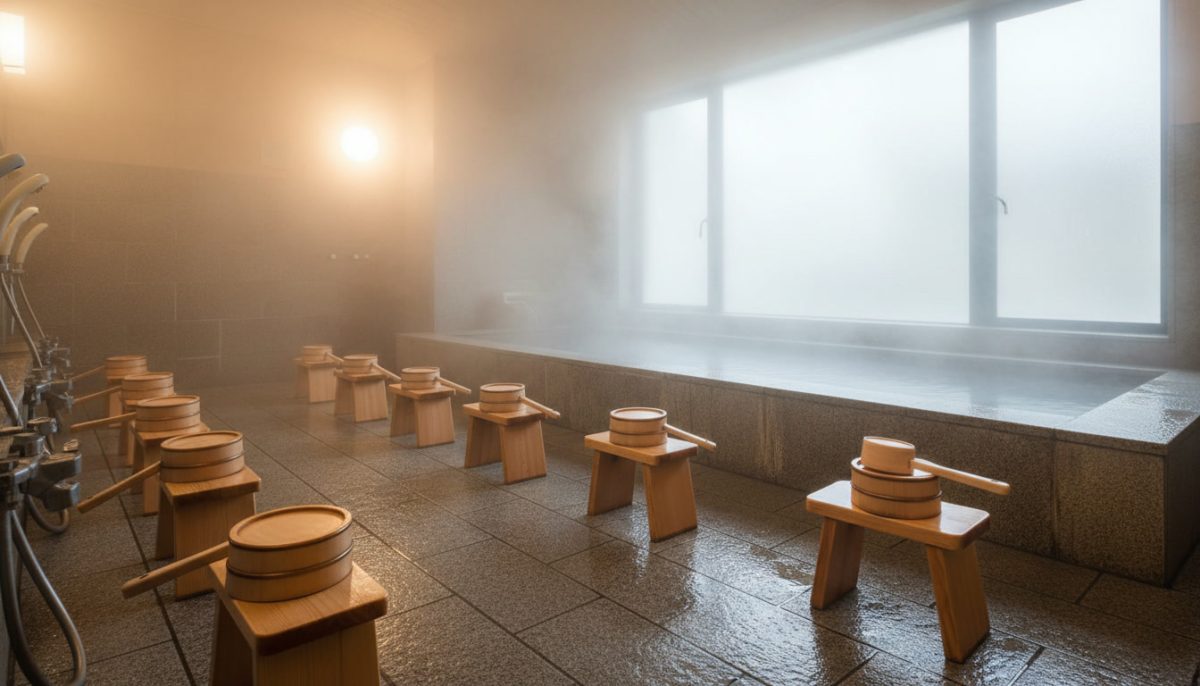
Before entering any shared bath, you must wash your body thoroughly at one of the washing stations (洗い場, araiba). These stations are arranged in rows, each with a low stool, a handheld showerhead, and dispensers of shampoo and body soap.
Sit on the stool. Wet your body. Lather, scrub, and rinse — everywhere. Hair, too, if you plan to submerge your head (though most people keep their head above water).
Why this matters: The bath is shared water. Every person who enters the tub is sitting in the same water. Washing first is not optional — it is the foundation of the entire system. If you skip this step, you will be asked to go back and wash. It is the one rule that is genuinely enforced.
Step 4: Kakeyu (掛け湯) — The Transition
After washing, and before entering the bath, scoop hot water from the tub (or from a dedicated kakeyu basin, if one is provided) and pour it over your body. This serves two purposes: it acclimates your body to the water temperature, preventing the shock of stepping into hot water, and it is a final rinse.
At strongly heated baths — some natural springs run above 42°C (108°F) — kakeyu is not just etiquette, it is self-preservation. Entering very hot water without acclimatizing can cause dizziness or a sudden drop in blood pressure.
Step 5: Enter the Bath
Lower yourself in slowly. Find a comfortable spot. Most baths have a ledge or a shallow area where you can sit with the water at chest level.
A few things to keep in mind while soaking:
- Your small towel does not go in the water. Fold it and place it on your head or on the edge of the tub. This is perhaps the most iconic image of Japanese bathing — the neatly folded towel balanced on the bather’s head.
- Keep your voice low. Conversation is fine, but the default atmosphere is quiet. Think of it as a library where people happen to be naked and wet.
- Do not swim, splash, or dunk your head. The bath is for soaking, not for exercise.
- Limit your time. Fifteen to twenty minutes per soak is a reasonable guideline, especially in very hot water. You can always get out, cool down, and go back in.
Step 6: Cool Down and Repeat (or Don’t)
After soaking, step out of the bath and sit on the edge or at a washing station to cool down. Many experienced bathers follow a pattern: soak, rest, soak, rest — two or three cycles over the course of an hour.
Some onsen have multiple baths at different temperatures, or different mineral compositions. Moving between them is part of the experience.
Step 7: Dry Off Before Returning to the Changing Room
Before stepping back into the changing room, wring out your small towel and use it to wipe down your body. The goal is to avoid dripping water all over the changing room floor. You do not need to be completely dry — just not visibly dripping.
Step 8: Get Dressed, Hydrate, Leave Better Than You Arrived
Most onsen have a rest area or lounge near the exit. Cold water, tea, or milk (a post-bath tradition) is usually available. Sit for a few minutes. Your muscles are warm, your skin is soft, and your blood pressure may be slightly lower than usual. There is no rush.
The Tattoo Question: Honest Answers
This is the single most common question asked by international visitors planning an onsen trip, and it deserves a complete, honest answer rather than a vague reassurance.
The Current Situation
Historically, tattoos in Japan were associated with organized crime (yakuza). Many onsen facilities — particularly large, commercially operated public baths — adopted blanket bans on visible tattoos. This policy persists at a significant number of establishments, though it is gradually changing.
In practice, the situation in 2026 breaks down roughly like this:
Large public onsen complexes and “super sento” chains: Most enforce a no-tattoo policy. Some check at the entrance. Small tattoos can sometimes be covered with bandages or skin-colored patches sold at convenience stores, but this is not guaranteed to work.
Small, traditional ryokan and hitō inns: Policies vary. Many do not have a formal policy. Some are welcoming to tattooed international guests because they understand the cultural difference. Others maintain the traditional stance. The only way to know is to ask.
Private baths (kashikiri): Always an option regardless of tattoos. You are in a private room. Nobody sees your body.
How to Navigate This
Before booking, send a short email. A simple message in English — “I have tattoos. Are tattooed guests welcome at your onsen?” — will get a direct answer from most inns. This takes two minutes and eliminates all uncertainty.
Use the private bath option. Kashikiri baths are widely available, comfortable, and often more relaxing than shared baths anyway. Budget ¥2,000–¥5,000 per session.
Check dedicated resources. Several websites maintain updated lists of tattoo-friendly onsen facilities across Japan, searchable by region. These lists are not exhaustive, but they are a useful starting point.
Do not try to hide a large tattoo with bandages in a shared bath. If the facility has a policy, it is better to respect it and use a private bath instead. Attempting to circumvent the rule puts both you and the staff in an uncomfortable position.
Common Mistakes (And Why They Are Not the End of the World)
Forgetting to wash before entering the bath. If you catch yourself, step out, go to a washing station, and wash. If someone else points it out, thank them and go wash. No permanent damage done.
Bringing a large towel into the bathing area. Some first-timers bring their full-sized bath towel from the changing room. This is not a catastrophe — just leave it at the washing station, not in the tub.
Standing when everyone else is sitting. The default posture at washing stations is seated on the low stool. Standing up sends water and soap spray in all directions, which is inconsiderate to neighbors. Sit down.
Taking photos. Do not. Ever. Under any circumstances. This is the one area where there is no room for “I didn’t know.” Phones stay in the locker. This is non-negotiable.
Getting the gender entrances mixed up. It happens. The characters 男 and 女 are similar enough at a glance. If you realize you have walked into the wrong side, turn around, leave calmly, and enter the correct one. It is an honest mistake that staff have seen a thousand times.
Onsen With Children: What to Know
Japanese families bring children — including infants — to onsen regularly. It is a normal part of family life, not an adult-only activity.
General guidelines:
- Children follow the same rules as adults: wash before entering, no running, no splashing.
- Very young children who are not toilet-trained should use the family or private bath option rather than shared public baths. Most facilities expect this.
- Many ryokan offer family-friendly rooms with in-room baths, making the logistics significantly easier.
- Children tend to find the water too hot. Cooler baths (if available) or shorter soaking sessions are practical adjustments.
What to Bring (And What Not To)
Bring
- A small modesty towel. Most onsen provide one, but having your own is practical. It is used to cover yourself while walking between the washing area and the bath, and to wipe down before returning to the changing room.
- Your own shampoo and body soap (if you are particular). Most onsen provide dispensers, but quality varies.
- A hair tie if you have long hair. Hair should be kept out of the bath water.
- A waterproof bag for your wet towel after bathing.
- Cash. Especially at smaller or rural onsen, which may not accept credit cards.
Do Not Bring
- Your phone. Leave it in the locker. Seriously.
- A swimsuit. You will not need it, and wearing one in a shared bath is not permitted.
- Jewelry. Sulfur and other minerals can damage and discolor metal. Leave rings, necklaces, and watches in the locker.
- Strong fragrances. Perfume, cologne, and scented lotions can affect the water quality and disturb other bathers.
The Unwritten Rules (The Ones Nobody Tells You)
These are not posted on any sign, but experienced onsen-goers follow them instinctively.
Rinse the stool and basin after using them. When you finish at the washing station, pour a bucket of water over the stool and the basin to clean them for the next person. This small gesture is noticed and appreciated.
Do not stare. The bathhouse is a shared space of vulnerability. People of all ages and body types use onsen. The cultural norm is to treat other bathers as invisible — or rather, to grant them the same privacy you would want for yourself.
Bow slightly when entering and leaving. This is not a formal requirement, but a small nod or bow when you enter the bathing area is a natural social gesture. It says: I am here, I respect this space, I will not cause problems.
The bath water is not for drinking. Some springs have a separate drinking fountain (飲泉, insen) where you can taste the mineral water. The bath itself is not it.
FAQ
Can men and women bathe together? In standard onsen, no — baths are gender-separated. Mixed bathing (konyoku) exists at a small number of traditional inns, usually with specific rules and scheduled times. Private baths (kashikiri) are always an option for couples or mixed groups.
Is it rude to talk in an onsen? No, quiet conversation is fine. But the general atmosphere is calm and low-volume. Save the animated group discussions for the restaurant afterward.
What if I feel faint or dizzy? Hot water lowers blood pressure. If you feel lightheaded, exit the bath slowly, sit on the edge, and drink water. This is common and nothing to be embarrassed about. Avoid alcohol before bathing.
Do I tip onsen staff? No. Tipping is not practiced in Japan, including at onsen and ryokan.
Can I use an onsen during menstruation? This is a personal decision. Some women use onsen during their period without issue. There is no formal rule prohibiting it, though some onsen post requests asking guests to refrain. Private baths are a comfortable alternative if you prefer.
Are onsen wheelchair accessible? Accessibility varies significantly. Newer, larger facilities tend to have better accessibility features. Traditional hitō inns, often located in mountain areas with stairs and uneven terrain, are generally not accessible. Contact the facility directly to ask about specific accommodations.
Can I bring my own food or drinks into the bathing area? No. Food and drinks stay in the changing room or designated rest areas. The only exception is the water bottle you might keep at the edge of the bath for hydration.
It Gets Easier After the First Time
Every person who has visited an onsen for the first time had the same thought in the changing room: “Am I really doing this?” And every person who has visited an onsen more than once had a different thought: “Why didn’t I do this sooner?”
The etiquette exists to make the experience better, not harder. Once you know the sequence — wash, rinse, soak, be quiet, dry off — the rest takes care of itself. The water does not care whether you are Japanese or foreign, young or old, covered in tattoos or unmarked. It is the same temperature for everyone.
Your only job is to get in.
This guide is part of THE Onsen Times’ coverage of Japanese hot spring culture. For a deeper look at Japan’s hidden springs and healing traditions, read our guide to Hitō, Toji, and the Quiet Art of Onsen.