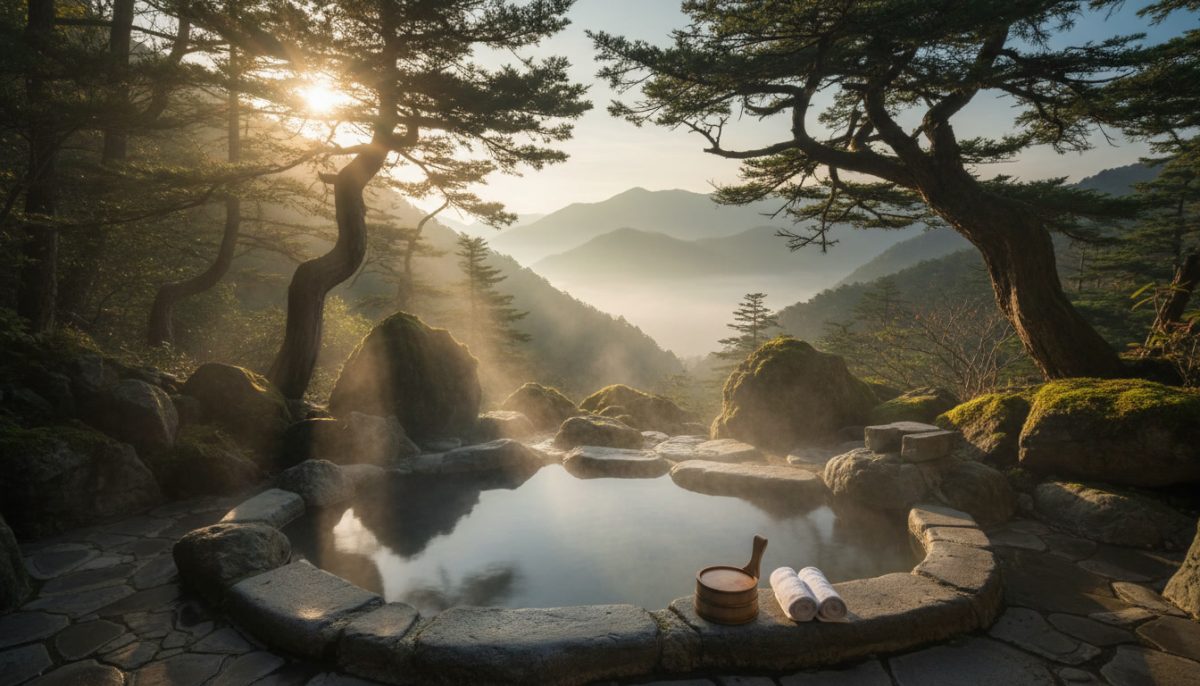


Some trips are built around sights. Others are built around silence.
If you have ever stepped into a famous onsen town — surrounded by tour buses, souvenir shops, and the hum of a hundred conversations — and thought, “this isn’t what I came for,” then this guide was written for you.
In Japan, the deepest kind of soaking does not happen in the places most easily reached. It happens on quiet mountain roads, in wooden buildings older than your grandparents, in water that smells of sulfur and iron, after a walk long enough to make your legs ache. The Japanese have a word for these places: hitō (秘湯) — secret hot springs. And there is a tradition of staying in them not for one night, but for weeks: toji (湯治), the old practice of healing through water.
This is not a list of “Top 10 Onsen.” This is a guide to going one step deeper.
What Hitō Really Means (And Why “Hidden Gem” Doesn’t Cover It)
Every travel website uses the phrase “hidden gem.” It has lost all meaning. Hitō is something more specific than that.
The word combines two kanji: 秘 (hi, secret) and 湯 (tō, hot water). But the cultural weight of hitō goes beyond etymology. In practice, a hitō is a hot spring that has remained small, remote, and largely unchanged — not because it was forgotten, but because someone chose to protect it.
Since 1975, the Japan Association of Secluded Hot Spring Inns (日本秘湯を守る会, Nihon Hitō wo Mamoru Kai) has maintained a network of member inns across the country. Their guiding philosophy is captured in a single line: “Hitō wa hito nari” — the hot spring is its people. Membership is selective. An inn must be small, traditionally managed, and situated in a natural environment that has not been commercialized. There are no neon signs. No karaoke bars. Often, no cell phone signal.
You can browse the full list of member inns on the association’s official website, which includes an English-language directory searchable by region and features such as outdoor baths, mixed bathing, or self-catering stays.
What makes hitō different from simply “a rural onsen” is intention. These are places where inconvenience is not a flaw — it is the filter. The two-hour bus ride, the unpaved road, the lack of a convenience store within walking distance: all of these serve to keep the experience quiet. If you are willing to accept the inconvenience, what waits on the other side is a quality of stillness that no luxury hotel can manufacture.
The Ritual, Not the Rules: Onsen Etiquette for the Quiet-Minded
You already know the basics. Wash before you enter. No swimsuits. Towels stay out of the water. Every English-language travel site covers these points, and they are correct.
But etiquette, at its best, is not a set of prohibitions. It is a set of small gestures that connect you to the place. Here are the ones that matter most at a hitō — and why.
Kakeyu (掛け湯): The Greeting You Give to the Water
Before stepping into the bath, you scoop hot water from the tub and pour it over your body. This is called kakeyu. Most guides describe it as a hygiene measure, and it is — but in the context of a hitō, where you might be the only guest, it serves a quieter purpose. It is a moment of adjustment: your body acclimates to the temperature, your breathing slows, and you shift from “arriving” to “being here.”
At some traditional inns, you will find a wooden bucket (called a kakeyu oke) beside the bath specifically for this purpose. Use it. The ritual takes fifteen seconds, but it changes the quality of your entire soak.
The Water Stays on Your Skin
At mineral-rich hot springs — particularly sulfur springs (硫黄泉, iōsen) and sodium chloride springs (食塩泉, shokuensen) — many regulars avoid rinsing off with fresh water after bathing. The idea is that the minerals continue to work on your skin after you leave the bath. This is not a hard rule, and some people with sensitive skin prefer to rinse. But if you notice that local bathers walk straight from the tub to the changing room without showering, now you know why.
Tattoos: Not a Dealbreaker, but Plan Ahead
The situation with tattoos at Japanese hot springs is more nuanced than the blanket “tattoos are banned” warning suggests. Policies vary widely from inn to inn. Many large, urban onsen facilities do prohibit visible tattoos. But at small hitō inns, the atmosphere tends to be more personal and less corporate.
Your best options if you have tattoos:
- Kashikiri (貸切風呂): A private bath that you can reserve for yourself or your group. Many ryokan offer this, and it completely sidesteps the tattoo question. Typical cost is ¥2,000–¥5,000 for 45–60 minutes.
- In-room baths (部屋付き風呂): Some higher-end rooms come with their own private onsen bath fed by the same natural spring water.
- Ask directly: A polite email before booking — in English or Japanese — will almost always get you a straight answer. Most small inns are glad to accommodate international guests who show respect for the space.
The Water Itself: What Makes Each Spring Different
Not all onsen water is the same. Japan’s Ministry of the Environment classifies hot spring water into ten main categories based on mineral composition, and the differences are not academic — you can feel them, smell them, and sometimes see them.
| Water Type | Japanese | What You Notice |
|---|---|---|
| Simple thermal | 単純温泉 | Clear, mild, gentle on skin. The “beginner-friendly” spring. |
| Sulfur | 硫黄泉 | Sharp egg-like smell, milky blue or white water. Iconic. |
| Sodium chloride | 食塩泉 | Slightly salty taste on your lips. Skin feels warm long after bathing. |
| Iron | 含鉄泉 | Reddish or brown water. Metallic tang. Stains towels. |
| Carbonated | 炭酸泉 | Tiny bubbles cling to your skin like champagne. Rare and prized. |
| Acidic | 酸性泉 | Stings slightly on cuts. Strong antibacterial properties. Kusatsu is famous for this. |
| Hydrogen carbonate | 炭酸水素塩泉 | Silky, slippery feel. Known as “beauty water” (美人の湯). |
At a hitō, the innkeeper will often know the exact composition of their water and its traditional uses. Do not hesitate to ask — in many cases, the water is the reason the inn exists at all.
Destination Deep Dive: Yunomine Onsen on the Kumano Kodo
If you are looking for one place that combines everything this guide is about — pilgrimage, silence, mineral water, and cultural depth — Yunomine Onsen in Wakayama Prefecture is that place.
The Journey
Yunomine sits in a narrow valley along the Kumano Kodo pilgrimage trail, one of only two pilgrimage routes in the world designated as a UNESCO World Heritage Site (the other is the Camino de Santiago in Spain). The village is small — a single street along a stream, a handful of inns, no traffic lights. Getting there requires a bus from Kii-Tanabe or Shingū station, and the ride takes roughly 90 minutes through mountain roads.
This is not a place you stumble upon. You go to Yunomine because you decided to.
The Water
Yunomine’s spring water has been used continuously for over 1,800 years, making it one of the oldest documented hot springs in Japan. The water is sodium hydrogen carbonate, slightly alkaline, and runs at approximately 92°C (198°F) at its source — hot enough that locals use it to boil eggs and vegetables in a communal cooking area beside the stream.
Tsuboyu: The Only Bathable World Heritage Hot Spring
At the center of the village is Tsuboyu (つぼ湯), a tiny stone-walled bathing enclosure built directly over a natural spring. It is the only hot spring in the world where you can bathe that holds UNESCO World Heritage status.
Tsuboyu operates on a first-come, first-served basis. You purchase a ticket at the nearby tourism office, then wait your turn. Each session is limited to 30 minutes. The bath fits two people comfortably — three if you are very good friends.
The experience is worth the wait. The water changes color throughout the day — from clear to pale blue to milky white — depending on temperature and mineral concentration. You sit in a stone basin barely larger than a bathtub, inside a wooden hut with a door you latch from the inside, listening to the river outside. There is nothing else.
Practical details: Tsuboyu is open daily, typically from 6:00 AM to 9:00 PM. The fee is ¥800 per person (as of the most recent published rates — check the Tanabe City tourism website for current pricing). Wait times vary by season; early morning visits on weekdays tend to be shortest.
Toji: The Art of Staying Long Enough to Actually Feel Something
Modern travel is built around efficiency. See the thing, take the photo, move to the next thing. Toji is the opposite of that.
Toji (湯治) means, literally, “healing by hot water.” The tradition dates back centuries: people with chronic pain, skin conditions, or simple exhaustion would travel to an onsen and stay for two to three weeks, bathing multiple times per day and eating simple meals between soaks. It was not a vacation. It was a medical treatment prescribed by doctors, covered by some forms of traditional health insurance, and structured around a daily rhythm of water, food, rest, and walking.
Jisui: The Self-Catering Stay
Many toji inns offer a jisui (自炊) option — self-catering rooms with a shared kitchen. You buy groceries at a local shop (or bring them with you), cook your own meals, and manage your own schedule. The rooms are simple: a futon, a low table, a kettle. The cost is significantly lower than a standard ryokan stay, often ¥3,000–¥5,000 per night without meals.
This style of travel appeals to a specific kind of visitor: someone who does not need to be entertained. The daily rhythm at a jisui toji inn looks something like this:
Morning: Wake up. Walk to the bath. Soak for 20 minutes. Return to your room. Make tea. Eat a simple breakfast — rice, miso soup, pickled vegetables, an egg.
Midday: Walk along the river or into the hills. Read. Nap. Soak again.
Evening: Cook dinner with whatever you found at the local market. Soak a third time. Sleep early, because there is nothing else to do — and because, by your third day, you will not want anything else to do.
The toji experience is, at its core, a form of voluntary simplicity. You give up choice, stimulation, and connectivity. In return, you get an experience that many travelers describe — without irony — as the most restful period of their adult lives.
Where to Try Toji
The Tōhoku region (northeastern Honshū) is the traditional heartland of toji culture. Inns such as Ōnuma Onsen (大沼温泉) in Naruko, Miyagi Prefecture, have offered jisui stays for generations and maintain English-language information for international guests. Nyūtō Onsen (乳頭温泉郷) in Akita Prefecture is another cluster of traditional inns where toji-style extended stays are available, though winter access requires careful planning due to heavy snowfall.
Essential Tips for the Quiet-Minded Traveler
Getting There
- Google Maps has limits in rural Japan. Bus schedules for mountain routes are not always current in Google Maps. Check the local bus company’s website directly, or ask your inn to send you the latest timetable. Many will do so by email in English.
- The last bus matters. In remote areas, the final bus of the day may leave at 3:00 or 4:00 PM. Miss it, and you are calling a taxi — if one is available.
- Rent a car if you can. For hitō in the mountains of Tōhoku, Kyūshū, or Shikoku, a rental car transforms a logistically stressful trip into a relaxing one. International driving permits are accepted in Japan.
Seasons
- Winter (December–March): The most photogenic season — snow-covered baths (yukimi-buro, 雪見風呂) are iconic. But road closures, reduced bus service, and sub-zero temperatures are real. Confirm access with your inn before booking.
- Autumn (October–November): Foliage season. Popular even at remote inns. Book early.
- Spring (April–May): Mild weather, fewer crowds, and cherry blossoms at lower elevations. An underrated sweet spot.
- Summer (June–August): Rainy season (June) can cause landslides and road closures in mountain areas. July and August are hot and humid at lower elevations, but mountain onsen remain cool and pleasant.
Useful Japanese Phrases
You do not need to speak Japanese to visit a hitō, but a few phrases go a long way:
- “Kashikiri-buro wa arimasu ka?” (貸切風呂はありますか?) — Do you have a private bath?
- “Tattoo ga arimasu ga, daijōbu desu ka?” (タトゥーがありますが、大丈夫ですか?) — I have a tattoo, is that okay?
- “Jisui-pran wa arimasu ka?” (自炊プランはありますか?) — Do you have a self-catering plan?
- “Onsen no seibun wa nan desu ka?” (温泉の成分は何ですか?) — What is the mineral composition of the spring?
What to Bring
- Your own towel. Most hitō inns provide towels, but they are small. Bringing a larger bath towel is practical.
- Cash. Many remote inns do not accept credit cards. Withdraw enough yen before leaving the nearest city.
- A book. There will be no TV worth watching, and that is the point.
- Sandals or easy slip-on shoes. You will be walking between your room and the bath several times a day.
Onsen Glossary for the Quiet-Minded
Understanding these terms will deepen your experience — and help you read Japanese inn websites.
- Hitō (秘湯): Remote hot springs where the journey is part of the value. Protected by tradition and intentional simplicity.
- Toji (湯治): Hot spring therapy stays, traditionally long enough — two to three weeks — to reset body and mind.
- Jisui (自炊): Self-catering style often linked to longer toji stays. You cook your own meals in a shared kitchen.
- Kakeyu (掛け湯): The act of pouring hot water over your body before entering the bath. A ritual of respect and physical adjustment.
- Kashikiri (貸切風呂): A reservable private bath. Ideal for tattoos, families, or anyone who prefers privacy.
- Rotenburo (露天風呂): An outdoor bath, often with views of mountains, rivers, or forest.
- Yukimi-buro (雪見風呂): Bathing while watching snow fall. A winter-specific experience.
- Konyoku (混浴): Mixed-gender bathing. Historically common, now increasingly rare. Approach with cultural sensitivity.
FAQ
Is it safe to visit a remote onsen alone? Yes. Japan is one of the safest countries in the world for solo travelers, and onsen towns — even very remote ones — are welcoming to visitors. The main practical risks are weather-related (winter road closures, summer landslides), not safety-related.
How much does a hitō stay cost? A standard room with two meals (一泊二食, ippaku nishoku) at a hitō inn typically costs ¥8,000–¥15,000 per person per night. Jisui (self-catering) rooms are significantly cheaper, often ¥3,000–¥5,000 per night.
Can I visit an onsen as a day trip? Many hitō inns offer day-use bathing (日帰り入浴, higaeri nyūyoku) for ¥500–¥1,000. This lets you experience the water without staying overnight. Call ahead to confirm availability, as some inns restrict day-use hours.
Do I need to speak Japanese? No, but it helps. At small rural inns, staff may speak limited English. A translation app on your phone and a few memorized phrases (see above) will cover most situations. Many inns are accustomed to international guests and will go out of their way to communicate.
What if I have sensitive skin? Strongly acidic or sulfuric springs can irritate sensitive skin. If this concerns you, look for simple thermal springs (単純温泉, tanjun onsen), which are mineral-light and gentle. Ask the inn about their water type before booking.
How long should I stay for a toji experience? Traditionally, toji stays last two to three weeks. For a modern visitor, even three to four nights at a single inn — with no other agenda — can provide a meaningful sense of the toji rhythm. The key is not length, but the decision to stop moving.
A Quiet Kind of Japan
Japan is famous for speed — bullet trains, robotic efficiency, the neon blur of Shibuya crossing. But the country’s oldest tradition is not speed. It is water.
For over a thousand years, people in Japan have traveled to hot springs not for spectacle, but for restoration. They walked mountain paths, slept in wooden rooms, ate simple food, and sat in water until the tension left their bodies. The places where they did this still exist. Many of them have not changed in generations.
If your idea of travel includes silence, mineral water, and the particular satisfaction of earning your bath through a long walk, these places are waiting for you.
You just have to be willing to go one step further than the guidebook suggests.
THE Onsen Times is an independent editorial guide to Japan’s hidden hot springs, traditional healing stays, and the quiet side of onsen culture. Read more about our editorial approach on our About page.