

You spent months planning a trip to Japan. You have a detailed spreadsheet of trains and temples. And then you read somewhere online that your sleeve tattoo might get you turned away from an onsen.
Take a breath. You are not banned from every hot spring in Japan. Not even close.
The tattoo situation at Japanese onsen is real, but it is also more manageable — and more nuanced — than most English-language travel advice suggests. This guide gives you the full picture: why the policy exists, where it does and does not apply, and the specific strategies that let you experience Japan’s bathing culture without anxiety.
Why Tattoos Are Restricted at Some Onsen
The short answer: historical association with organized crime.
The longer answer: During Japan’s postwar decades, visible tattoos became closely linked with yakuza (organized crime groups), who used elaborate full-body tattoos (irezumi) as a mark of membership and loyalty. As public bathhouses sought to discourage yakuza presence — both for the comfort of other guests and for legal reasons — many adopted blanket bans on visible tattoos.
This policy was practical in its original context. A bathhouse owner in the 1970s did not need to evaluate each tattooed visitor individually; the cultural association was strong enough that a no-tattoo rule effectively filtered out the clientele they wanted to avoid.
The problem, from a modern perspective, is that the world changed. International tourism increased. Tattoos became a mainstream form of personal expression in most Western countries, with no criminal association whatsoever. A visitor from Berlin or Melbourne with a small wrist tattoo has nothing in common with a yakuza member — but the rule, in places where it still exists, does not distinguish between the two.
The Shift That Is Already Happening
Japan’s relationship with tattoo policies has been evolving steadily, accelerated by several factors.
International tourism growth. As Japan has actively sought to increase inbound tourism — reaching a record-breaking number of international visitors in recent years — the economic incentive to accommodate tattooed travelers has grown.
Generational change. Younger Japanese people are increasingly likely to have tattoos themselves, particularly in urban areas. The automatic association between tattoos and crime is weakening with each generation.
Government signals. In 2015, Japan’s Tourism Agency sent a notice to onsen operators encouraging them to consider accommodating tattooed visitors, suggesting options like cover patches and private baths. This was not a mandate, but it signaled a direction.
The result is a landscape in transition. Some facilities have relaxed their policies entirely. Others have introduced compromise solutions. And some maintain the traditional ban. Your job as a visitor is not to change the culture — it is to navigate it comfortably.
Your Options: A Practical Framework
Rather than memorizing a list of specific facilities (which changes constantly), it is more useful to understand the categories of options available to you. Think of it as a decision tree.
Option 1: Private Baths (Kashikiri-Buro)
This is your most reliable option. A kashikiri-buro (貸切風呂) is a bath you reserve exclusively for yourself, your partner, your family, or your group. The door locks from the inside. Nobody else enters. Your tattoos are irrelevant.
How it works:
- Available at most mid-range and high-end ryokan, and at many day-use onsen facilities
- Typically bookable in 45–60 minute sessions
- Cost ranges from ¥2,000 to ¥5,000 per session at most places, though luxury ryokan may charge more
- Some ryokan include one free kashikiri session with an overnight stay
- Water quality is identical to the shared baths — it is the same spring
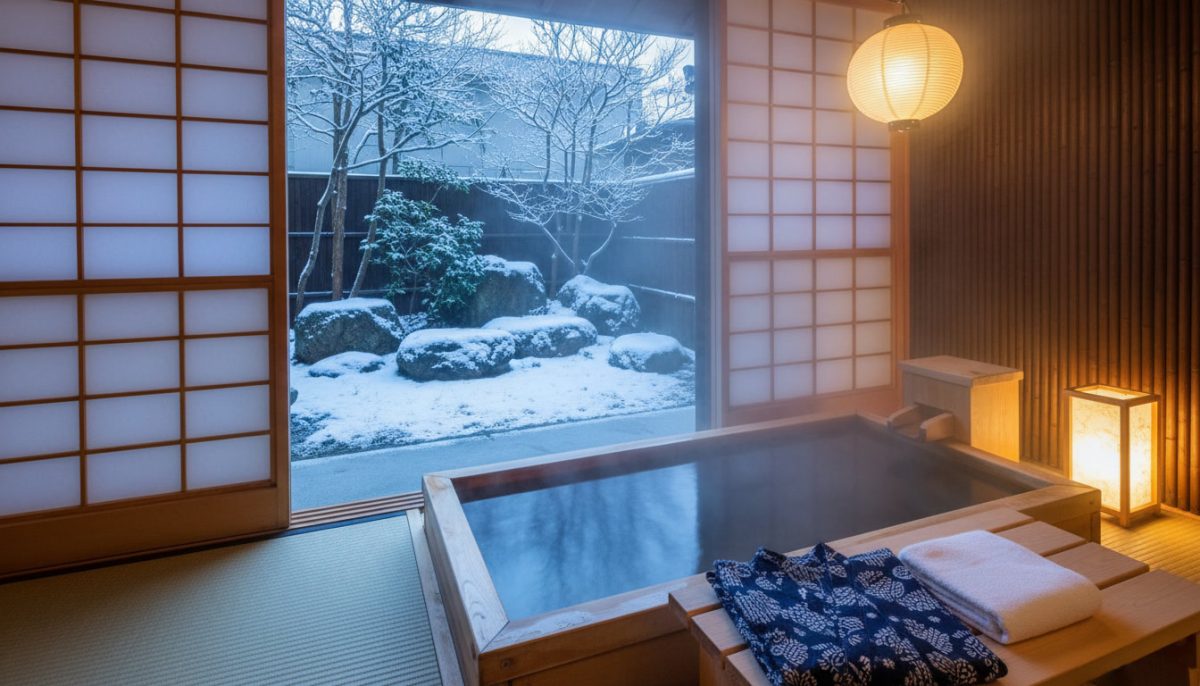
Why this is often the best option regardless of tattoos: A private bath at a good ryokan, late at night, with the window open to a mountain view and no other sound except water — that is an experience most travelers would pay for even if they had no tattoos at all.
Option 2: In-Room Baths (Heya-tsuki Onsen)
Some ryokan rooms come equipped with their own private onsen bath, fed by the same natural spring as the main facility. These are typically higher-end rooms and command a premium (¥20,000–¥50,000+ per night for the room), but the privacy is absolute and the convenience is unmatched.
This option is ideal for:
- Travelers with extensive tattoos who want zero friction
- Couples who prefer complete privacy
- Families with young children
- Anyone who wants to bathe at 3 AM without putting on a yukata
Option 3: Tattoo-Friendly Facilities
A growing number of onsen facilities explicitly welcome tattooed guests. These range from large, modern “super sento” complexes to traditional rural inns.
How to identify them:
- Some facilities display signs or website notices stating that tattoos are permitted
- Tourism board websites and dedicated online directories maintain searchable lists
- Google Maps reviews from international visitors often mention tattoo policies
- TripAdvisor and similar platforms have reviews that specifically address this question
A note of honesty: No static list will ever be perfectly current. Policies change. Ownership changes. A facility that was tattoo-friendly last year may not be this year, and vice versa. The most reliable approach is always to confirm directly with the specific facility before you visit.
Option 4: Tattoo Cover Patches
Some facilities that maintain a no-tattoo policy will accept guests who cover their tattoos with skin-colored adhesive patches. These are available at:
- Convenience stores (konbini) near popular onsen areas
- Drugstores (ドラッグストア) such as Matsumoto Kiyoshi or Welcia
- Online retailers (Amazon Japan delivers within one to two days in most areas)
Practical limitations:
- Works well for small to medium tattoos (wrist, ankle, shoulder)
- Impractical for large or full-sleeve tattoos
- The patches can peel off in hot water, especially at higher temperatures
- Not all facilities accept patches as a sufficient measure — ask before relying on this strategy
Option 5: Wild and Outdoor Hot Springs
Japan has numerous natural hot springs in outdoor, unmanaged settings — rivers, mountainsides, coastal areas — where there are no facilities, no staff, and no rules. These are called notenuro (野天風呂) or kawa-yu (川湯, river hot springs).
At these locations, there is no one to enforce any policy. You are simply bathing in nature.
Examples:
- Kawayu Onsen in Wakayama Prefecture, where you dig your own bath in a riverbed
- Numerous mountain streams in Hokkaido with naturally heated pools
- Coastal hot springs along the Izu Peninsula
Caution: These sites have no safety infrastructure. Water temperature can vary dramatically. Some are on private land. Exercise common sense and basic research.
How to Ask About Tattoo Policies (Without Awkwardness)
Whether you are booking by email, calling, or asking at the front desk, here are straightforward approaches.
By Email (English)
Subject: Question about tattoo policy
Hello,
I am planning to visit your onsen on [date]. I have tattoos and would like to confirm your policy regarding tattooed guests.
If tattoos are not permitted in the shared baths, do you offer private baths (kashikiri) as an alternative?
Thank you for your time.
This works. It is polite, direct, and gives the facility an easy way to offer a solution even if their shared baths have a no-tattoo rule.
By Email (Japanese)
件名:タトゥーについて
お世話になります。 [日付]に貴施設を訪問予定です。タトゥーがございますが、入浴は可能でしょうか。 共用浴場が難しい場合、貸切風呂のご利用は可能でしょうか。 ご確認いただけますと幸いです。 よろしくお願いいたします。
At the Front Desk
If you arrive without having asked in advance, a simple question works:
“Tattoo ga arimasu ga, daijōbu desu ka?” (タトゥーがありますが、大丈夫ですか?) — I have a tattoo, is that okay?
Staff will either say yes, direct you to a private bath, or politely explain the policy. In any case, you will know immediately and can proceed accordingly.
Region-by-Region Overview
Tattoo policies are not uniform across Japan. Geography, tourism density, and local culture all play a role.
Hokkaido
Generally more relaxed than the national average. Hokkaido has a strong independent tourism culture and many facilities catering to international visitors, particularly in the Niseko, Noboribetsu, and Jozankei areas. Private bath options are widely available.
Tohoku (Northern Honshu)
The heartland of traditional onsen culture. Many small, family-run hitō inns in the region have no formal tattoo policy because they have never needed one — their clientele has historically been Japanese. International visitors are less common, which means policies may be informal and flexible. Ask in advance.
Kanto (Tokyo Area)
The most restrictive region for tattoos, particularly at large commercial facilities. However, the sheer number of onsen options in the greater Tokyo area means that tattoo-friendly alternatives are always available. Day-trip onsen in Hakone and Izu offer private baths widely.
Kansai (Osaka, Kyoto)
Mixed. Urban super sento tend to enforce no-tattoo policies. Traditional ryokan in Kinosaki, Arima, and Shirahama are more variable. Kinosaki Onsen, where guests wear yukata and walk between multiple public bathhouses, has been gradually modernizing its approach to international visitors.
Kyushu
One of the most tattoo-tolerant regions. Beppu, with its extraordinary concentration of hot springs, has numerous facilities welcoming tattooed visitors. Kurokawa Onsen and Yufuin also tend to be accommodating, partly due to strong international tourism presence.
What NOT to Do
Do not lie about having tattoos. If a facility asks at the entrance and you deny it, you risk being asked to leave mid-bath — which is far more embarrassing than the initial conversation.
Do not argue with staff about the policy. The person at the front desk did not create the rule and cannot change it on the spot. A polite “I understand, thank you” preserves dignity on both sides.
Do not assume that a ban is personal. It is not about you. It is a cultural policy with a historical context. Disagreeing with it is entirely reasonable. Expressing that disagreement to a minimum-wage front desk worker at a rural bathhouse is not productive.
Do not post angry reviews about tattoo policies. Online reviews that read “1 star because they wouldn’t let my tattoos in” do not help future travelers and do not change policies. Constructive, factual notes — “This facility does not allow tattoos in shared baths but offers private baths for ¥3,000/session” — are genuinely useful.
Planning Your Trip: A Checklist
Here is a practical sequence for planning an onsen trip with tattoos.
Two weeks before your trip:
- Identify the onsen or ryokan you want to visit
- Check their website for any mention of tattoo policies
- Send an email asking about their policy and private bath availability
- Book private baths or in-room onsen rooms if needed
The day before your visit:
- If relying on cover patches, purchase them at a local drugstore and test the fit
- Confirm your reservation and any private bath bookings
On arrival:
- If you did not ask in advance, ask at the front desk before changing
- If the shared bath is not available to you, request a kashikiri session
- Relax. You have a plan. The water does not care about your ink.
FAQ
Are there onsen that specifically welcome tattoos? Yes, and the number is growing. Some facilities have removed their no-tattoo policies entirely. Others have created compromise solutions like designated hours or cover-patch options. The most reliable way to find current information is to contact the facility directly.
Can I use an onsen if I have a small tattoo? At many facilities, small tattoos that can be covered with a single adhesive patch are accepted. However, policies vary. Some facilities ban all visible tattoos regardless of size, while others only restrict large or full-body tattoos.
Is the private bath experience worse than the shared bath? No. In many cases, it is better. You get the same water, the same minerals, and the same temperature — but in complete privacy, on your own schedule, without any concern about policies or other guests.
How much does a private bath cost? Typically ¥2,000–¥5,000 for a 45–60 minute session. Some ryokan include a complimentary kashikiri session with overnight stays. Rooms with in-room onsen baths are more expensive (¥20,000+ per night) but offer unlimited private access.
Will staff check for tattoos at the door? At large commercial facilities, sometimes yes — particularly in urban areas. At small traditional inns, it is rare. If you asked in advance and received confirmation that tattoos are acceptable, there will be no issue.
Are tattoo policies different for non-Japanese visitors? Officially, policies apply equally to all guests. In practice, some facilities are more lenient with international visitors because staff understand the cultural difference. This is not something you can count on, but it does happen.
Is this situation improving? Yes, gradually. International tourism, generational change, and government guidance are all pushing in the direction of greater acceptance. But “improving” does not mean “resolved.” Planning ahead remains the most practical approach.
The Bigger Picture
The tattoo question is ultimately a small logistical challenge inside a much larger experience. Japan has tens of thousands of hot springs. Even in the most restrictive scenario — a traveler with extensive tattoos visiting the most policy-conscious region — there are always options: private baths, in-room baths, wild springs, tattoo-friendly facilities.
The worst outcome is not “I cannot use any onsen in Japan.” The worst outcome is “I let the tattoo question stop me from trying, and I missed one of the best experiences the country offers.”
Do not let that happen. Plan a little. Ask a polite question. Book a private bath. And get in the water.
This guide is part of THE Onsen Times’ coverage of Japanese hot spring culture. For the full bathing guide, read Onsen Etiquette: The Complete Guide. For deeper cultural context, see Hitō, Toji, and the Quiet Art of Onsen.