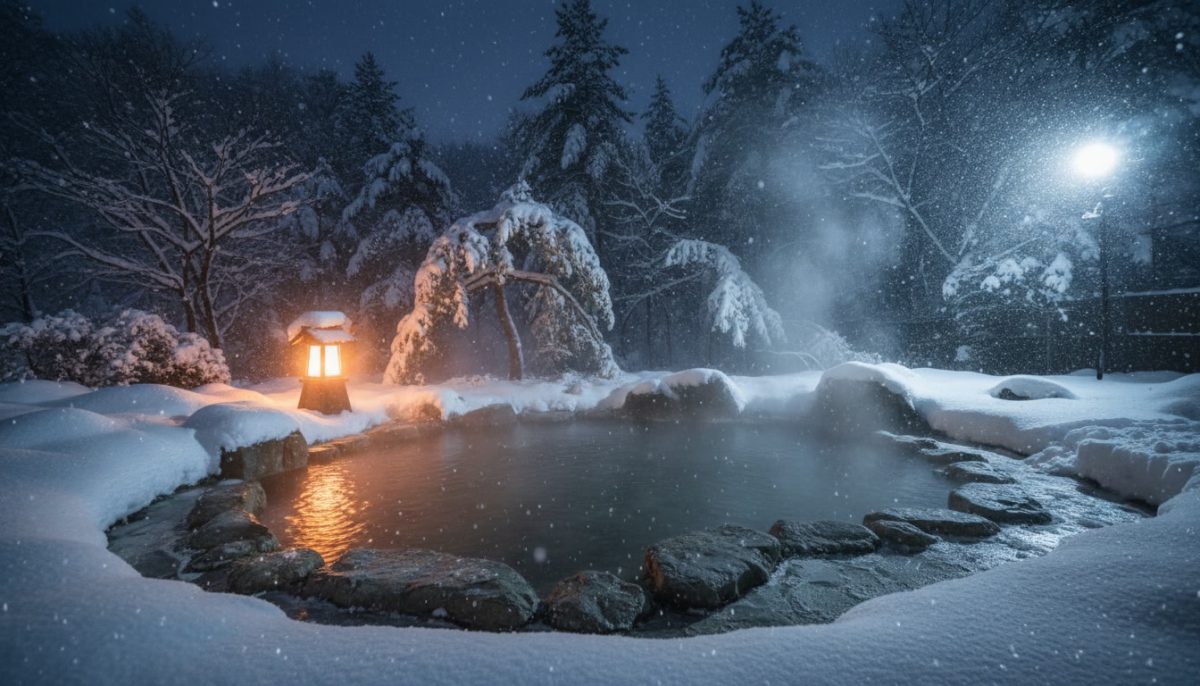


There is a photograph that appears in every Japan travel article at least once: a person soaking in a steaming outdoor bath while snow falls gently around them, the surrounding mountains white and silent. It is one of the most compelling images in all of travel photography, and it raises an obvious question: when should I go?
The honest answer is that every season offers a different version of the onsen experience, and none of them is wrong. But they are different — in atmosphere, in logistics, in cost, and in what the landscape gives you. This guide walks through each season so you can choose the one that matches what you actually want.
Winter (December – March): The Iconic Season
Why Winter Is Special
Winter is when onsen makes the most physical sense. The air temperature outside may be well below freezing. The water temperature inside the bath is 40–43°C (104–109°F). The contrast between the two is the entire experience.
Yukimi-buro (雪見風呂) — literally “snow-viewing bath” — is the word for this. You sit in hot water, steam rising from the surface, and watch snow accumulate on rocks, branches, and the edge of the tub. Your shoulders are warm. Your face is cold. The world is absolutely quiet because snow absorbs sound.
This is not a manufactured experience. It is a natural consequence of geography: Japan is one of the snowiest countries on earth, particularly along the Sea of Japan coast and in the northern mountains. Towns that receive three or four meters of snow per winter — Ginzan Onsen, Nyuto Onsen, Nozawa Onsen — have been offering this experience for centuries, long before anyone thought to photograph it.
Where to Go for Snow Onsen
Heavy snowfall (the full yukimi-buro experience):
- Ginzan Onsen, Yamagata — The Taisho-era wooden buildings draped in snow, lit by gas lamps, with steam rising from the river. Arguably the most photogenic onsen town in Japan during winter.
- Nyuto Onsen, Akita — Deep mountain snow, milky sulfur water, thatched-roof buildings. Tsurunoyu’s outdoor mixed bath in a snowstorm is unforgettable.
- Nozawa Onsen, Nagano — A ski village with thirteen free public bathhouses (sotoyu). Ski all day, soak all evening. The town’s hot spring eggs (onsen tamago) are cooked in a public cooking pool in the center of town.
- Zao Onsen, Yamagata — Famous for “snow monsters” (juhyo) — trees encased in ice and snow on the nearby mountain. The onsen water is strongly acidic and sulfuric.
Moderate snowfall (scenic but more accessible):
- Shirahone Onsen, Nagano — Milky white water surrounded by snow-dusted Northern Alps forest. Accessible by bus from Matsumoto.
- Takaragawa Onsen, Gunma — A large riverside rotenburo north of Tokyo, surrounded by snow-covered mountains. Reachable as a day trip from Tokyo, though an overnight stay is recommended.
The Trade-Offs of Winter
Access can be difficult. Mountain roads close. Bus services reduce frequency. Some inns shut down entirely from December through March. Always confirm that your chosen destination is operating and accessible before booking.
It books up fast. The yukimi-buro image is powerful marketing, and Japanese domestic travelers know it. December through February at popular snow onsen towns can sell out months in advance, particularly on weekends and during New Year (December 28 – January 3).
It is cold outside the bath. This sounds obvious, but the practical reality is that walking between your room and the outdoor bath in sub-zero temperatures — wearing only a yukata and sandals — requires a certain commitment. The walk is usually short (under a minute), but it is bracing.
Cost is highest in winter. Peak season pricing applies at most ryokan from late December through February.
Winter Packing List
- Warm layers for outdoor movement (the yukata alone is not enough between buildings in heavy snow)
- Waterproof boots or shoes with grip for icy paths
- Hand warmers (kairo, カイロ) — available at every convenience store
- A waterproof phone case if you want to photograph the rotenburo (but remember: no phones in shared bathing areas)
Spring (April – May): The Gentle Season
Why Spring Works
Spring in Japan is defined by cherry blossoms (sakura), and the overlap between sakura season and onsen creates a combination that is beautiful without being extreme. The air is mild — 15–20°C (59–68°F) at most elevations — which makes outdoor baths comfortable without the physical shock of winter.
Cherry blossoms at onsen towns tend to bloom slightly later than in major cities, because many onsen are at higher elevations or in northern regions. This means that if you miss the peak bloom in Tokyo (typically late March to early April), you can often catch it at an onsen town one to three weeks later.
Where to Go in Spring
- Takato Onsen, Nagano — Adjacent to Takato Castle Park, home to 1,500 cherry trees and considered one of the top three cherry blossom viewing spots in Japan. The blossoms here are a distinctive pink variety (Takato Kohigan-zakura) that is deeper in color than the standard Somei Yoshino.
- Kinosaki Onsen, Hyogo — The willow-lined canal that runs through town is bordered by cherry trees. Bathhouse-hopping in a yukata under a canopy of blossoms is Kinosaki at its best.
- Nyuto Onsen, Akita — Spring arrives late in northern Tohoku. The beech forests around Nyuto burst into fresh green in late April and May, and the transition from lingering snow to new growth is dramatic.
- Yoshino, Nara — The most famous cherry blossom mountain in Japan, with 30,000 trees across four elevation zones that bloom sequentially over several weeks. Nearby Yoshino Onsen provides a base for viewing.
The Trade-Offs of Spring
Timing is unpredictable. Cherry blossom season is notoriously weather-dependent. The Japan Meteorological Corporation publishes forecasts, but a warm spell or a cold snap can shift peak bloom by a week or more.
Golden Week (April 29 – May 5) is chaos. This national holiday week is the busiest domestic travel period in Japan. Onsen towns that are normally quiet become crowded, and prices spike. Avoid this week if possible. If you must travel during Golden Week, book months in advance.
Summer (June – August): The Underrated Season
Why Summer Deserves Consideration
Summer is the least popular season for onsen travel among international visitors, and that is precisely why it deserves consideration. The crowds thin. The prices drop. And the experience, while different from winter, has its own appeal.
The key insight about summer onsen is altitude. At sea level and in the lowlands, June through August in Japan is hot and humid — genuinely uncomfortable. But mountain onsen at 800 meters and above remain cool and pleasant, often 5–10°C (9–18°F) cooler than the nearest city.
There is also the matter of fireflies (hotaru). In late June and early July, fireflies emerge along rivers and streams near many onsen towns, creating a natural light show that pairs remarkably well with an evening soak.
Where to Go in Summer
- Kurokawa Onsen, Kumamoto — The forested gorge stays cool even in summer. Fewer visitors than autumn or winter, and the ryokan are grateful for the business.
- Okuhida Onsengo, Gifu — At the foot of the Northern Alps, summer temperatures are mild. The concentration of riverside rotenburo makes this an ideal summer bathing destination.
- Osawa Onsen, Iwate — A Tohoku classic with a large riverside mixed bath that feels like a natural swimming hole. In summer, the river is warm enough to wade in before or after soaking.
- Shirahone Onsen, Nagano — At 1,400 meters, summer here feels like spring in the lowlands. The milky white water is equally striking against green forest as it is against snow.
The Trade-Offs of Summer
Rainy season (tsuyu) runs from early June to mid-July in most of Japan (except Hokkaido, which largely skips it). Heavy rain can cause landslides and road closures in mountain areas. Monitor weather forecasts and have flexible plans.
Insects. Mountain onsen in summer mean mosquitoes. Outdoor baths at dusk are prime mosquito time. Bring repellent, or choose an indoor bath for evening soaks.
Some rotenburo close or limit hours during extreme heat to prevent heat-related illness among bathers.
Autumn (October – November): The Photographers’ Season
Why Autumn Rivals Winter
If winter is the iconic onsen season, autumn is the sophisticated one. Japanese maples, ginkgo, and beech trees turn the landscape into gradients of red, orange, and gold. An outdoor bath surrounded by autumn foliage — koyo-buro (紅葉風呂) — is as visually stunning as a yukimi-buro, and considerably more comfortable in terms of air temperature.
Autumn foliage in Japan follows a predictable pattern: it begins in Hokkaido in late September and moves south, reaching Kyushu by late November. Mountain areas color earlier than lowlands. This means that with careful timing, you can match your onsen visit to peak foliage almost anywhere in the country.
Where to Go in Autumn
- Naruko Onsen, Miyagi — The Naruko Gorge (Naruko-kyo) is one of Tohoku’s premier autumn foliage destinations. The gorge walls, viewed from above or from the train that passes through, are a wall of red and gold from mid-October to early November.
- Kurokawa Onsen, Kumamoto — The forested gorge that makes Kurokawa appealing in summer becomes extraordinary in autumn. The contrast between warm bath water and cool, color-saturated air is remarkable.
- Hakone, Kanagawa — Yes, Hakone is famous and frequently crowded. But in autumn, the combination of Lake Ashi, the surrounding mountains in full color, and the high density of quality onsen facilities makes it genuinely worthwhile. Midweek visits avoid the worst congestion.
- Nyuto Onsen, Akita — The beech forests that surround the seven inns produce a uniform golden-yellow canopy in October that is unlike the mixed reds and oranges found further south. It is subtler and, to many observers, more beautiful.
The Trade-Offs of Autumn
Peak foliage weekends are extremely busy. Japanese domestic travelers love koyo (autumn foliage viewing) as much as hanami (cherry blossom viewing). Weekend accommodations at popular onsen towns book out quickly in October and November.
Foliage timing is variable. Like cherry blossoms, the exact timing of peak color depends on weather conditions. Use online foliage forecasts to refine your plans, but build in flexibility.
Transition weather. October and November can bring unexpected cold snaps at higher elevations. Pack layers.
The Fifth Season: Late Night
There is one more “season” worth mentioning, and it has nothing to do with the calendar.
At a ryokan with 24-hour bath access, the best soak of the day is almost always the one at 11 PM or 6 AM — when the other guests are asleep. The bath is empty. The water is still. If it is a rotenburo, you might see stars, or the first light of morning touching the mountains, or nothing at all except steam and darkness.
This is the experience that no photograph captures and no season can claim exclusively. It is available year-round, at any inn that does not lock its baths at night. Ask when you check in: “Is the bath available all night?” (お風呂は夜通し入れますか? — Ofuro wa yodōshi hairemasu ka?)
If the answer is yes, set an alarm.
Season-by-Season Quick Reference
| Factor | Winter | Spring | Summer | Autumn |
|---|---|---|---|---|
| Atmosphere | Dramatic, stark | Gentle, hopeful | Lush, humid (lowlands), cool (mountains) | Vivid, warm-toned |
| Crowds | High (Dec–Feb) | Extreme (Golden Week) | Low | High (weekends) |
| Cost | Highest | Moderate–High | Lowest | Moderate–High |
| Access risk | Road closures, snow | Minimal | Rain, landslides | Minimal |
| Best for | Yukimi-buro, photography | Cherry blossoms, mild weather | Budget, solitude, fireflies | Foliage, comfortable temperature |
| Book ahead | 2–3 months | 1–2 months (3+ for Golden Week) | 2–4 weeks | 1–2 months |
FAQ
What is the single best month to visit an onsen in Japan? If forced to choose one: late October. The autumn foliage is at or near peak across much of the country, temperatures are comfortable for outdoor bathing, and the extreme crowds of summer holidays and New Year have not yet arrived. But this is a personal preference, not an objective ranking.
Can I experience yukimi-buro without going far from Tokyo? Yes. Nozawa Onsen and Takaragawa Onsen are both reachable from Tokyo in 2–3 hours. Hakone occasionally receives light snow in January and February. For heavy, reliable snowfall, plan on traveling to Tohoku (Ginzan, Nyuto) or the Japanese Alps.
Is it too hot to enjoy onsen in summer? At lowland onsen, summer bathing can feel uncomfortably warm. The solution is altitude: mountain onsen at 800+ meters remain pleasant. Alternatively, some facilities offer cooled baths (冷泉, reisen) during summer months.
Do outdoor baths close during bad weather? Policies vary. Light rain and snow generally do not close rotenburo — in fact, soaking during rain or snowfall is part of the appeal. Heavy storms, lightning, or extreme cold may prompt temporary closures. Staff will inform you.
Are there onsen experiences unique to a specific season? Yes. Sand bathing (sunamushi) in Ibusuki is available year-round but most pleasant in cooler months. Firefly viewing near onsen is limited to late June and early July. Ice-covered lakes visible from rotenburo are a winter-only phenomenon in Hokkaido and Tohoku.
When is the cheapest time to visit? Mid-January through February (after New Year crowds leave) and June through early July (rainy season deters many travelers) tend to offer the lowest ryokan rates. Midweek stays are almost always cheaper than weekends regardless of season.
Choose Your Season, Then Commit to It
Every season has trade-offs. Winter gives you the iconic photograph but demands logistical planning. Autumn gives you color but also crowds. Summer gives you solitude but also humidity. Spring gives you blossoms but also unpredictability.
The mistake is not choosing the wrong season. The mistake is spending so long deciding that you never book the trip at all.
Pick a season. Pick a place. Get in the water. It will be the right temperature regardless of the month.
This guide is part of THE Onsen Times’ seasonal coverage of Japanese hot spring culture. For regional recommendations, read Best Onsen in Japan by Region. For first-time visitors, start with Onsen Etiquette: The Complete Guide.