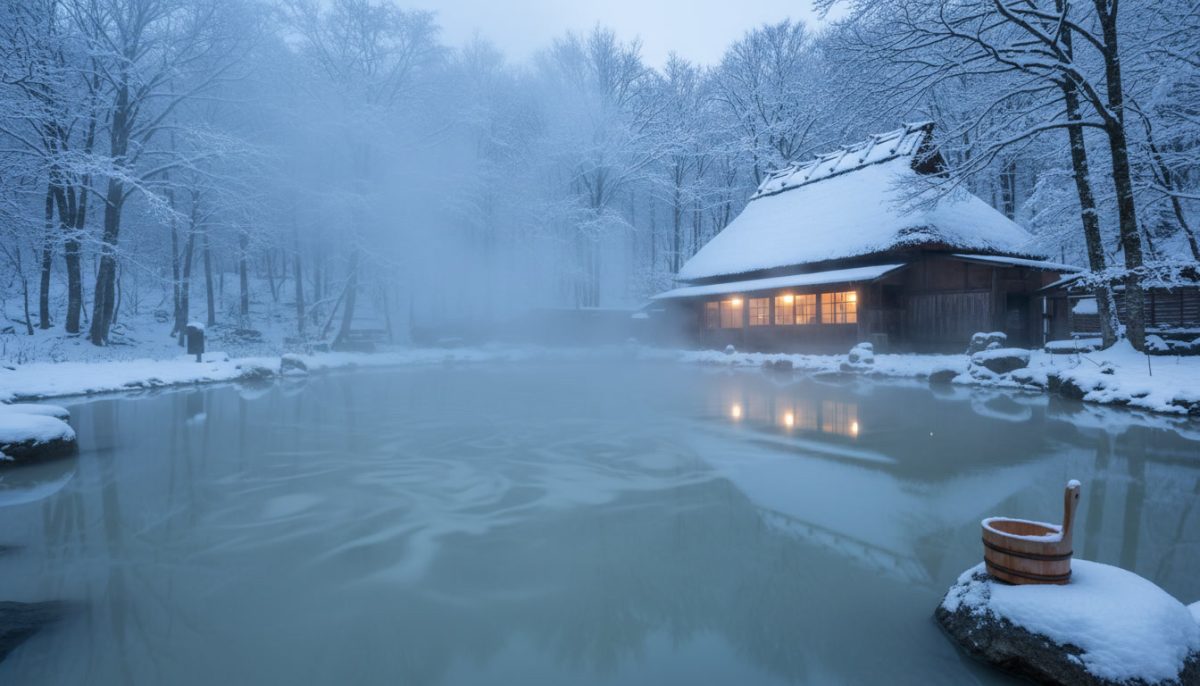


Seven inns. Seven different springs. One mountain road through beech forest that, in winter, disappears under two meters of snow.
Nyuto Onsen (乳頭温泉郷) is not a town. It is a loose cluster of traditional hot spring inns at the base of Mount Nyuto in Akita Prefecture, deep in the Towada-Hachimantai National Park. There are no shops, no restaurants outside the inns, and no reason to come here except the water.
That is exactly the point.
Why Nyuto Is Special
Most onsen towns share a single water source. Nyuto has seven inns, and each draws from its own distinct spring. The mineral compositions are different enough that you can feel the difference on your skin as you move from one bath to the next: milky white sulfur water at one, clear sodium chloride at another, iron-tinged brown at a third.
This variety within a small geographic area is genuinely rare. A pass called the Nyuto Onsen Meguri Tegata (湯めぐり帖) costs ¥1,800 and grants one visit to each of the seven inns’ baths. It turns a stay at Nyuto into a day-long exploration of water chemistry, architecture, and atmosphere.
The Seven Inns
Tsurunoyu (鶴の湯)
The oldest and most famous of the seven. Tsurunoyu dates to the 1600s, when it served as a bathing retreat for the local feudal lord. The main building retains its thatched roof and dark timber construction, and the atmosphere inside is closer to a museum than a modern hotel — except that the museum is heated, serves excellent food, and has some of the best baths in Japan.
The signature experience is the large outdoor mixed bath (konyoku), a natural pool surrounded by rocks and trees, fed by milky white sulfur water that rises directly from the ground beneath the bath. In winter, with snow falling and steam rising, it is one of the most photographed onsen scenes in the country.
Rooms are simple — futons on tatami, no television in the older buildings. The meals are mountain cuisine: wild vegetables, river fish, local mushrooms, and kiritanpo (pounded rice sticks), an Akita specialty.
Booking note: Tsurunoyu is extremely popular and books out months in advance, especially for winter weekends. Reserve as early as possible.
Ganiba Onsen (蟹場温泉)
Named for the freshwater crabs that once populated the nearby stream, Ganiba offers both indoor and outdoor baths with clear, sodium-bicarbonate water. The rotenburo is set among beech trees and feels more secluded than Tsurunoyu’s open pool. It is a quieter alternative for visitors who prefer privacy.
Magoroku Onsen (孫六温泉)
The most remote of the seven, accessible only by a short walking trail from the nearest road. Magoroku has no modern amenities to speak of — the buildings are old, the lighting is dim, and the bath is a simple wooden tub fed by a sulfur spring. This is the inn for travelers who want the rawest version of the Nyuto experience.
Ogama Onsen (大釜温泉)
Housed in a converted wooden schoolhouse, Ogama has an eccentric charm. The water is acidic and slightly cloudy. The building’s history as a school gives it a different atmosphere from the other inns — higher ceilings, larger common areas, a slight sense of institutional nostalgia.
Kuroyu Onsen (黒湯温泉)
“Black water” onsen. The water is not actually black but a dark, mineral-heavy sulfur spring. Kuroyu operates only from mid-April to late November because winter snowfall makes road access impossible. The outdoor bath sits beside a stream with views of the surrounding mountains.
Taenoyu (妙乃湯)
The most modern and polished of the seven. Taenoyu caters to visitors who want the Nyuto experience without the rustic austerity of Tsurunoyu or Magoroku. The baths are well-designed, the rooms are comfortable, and the food is a step above standard mountain fare. A good choice for first-time onsen visitors or couples.
Kyukamura Nyuto Onsenkyo (休暇村乳頭温泉郷)
A national park lodge with the most accessible facilities. Kyukamura has the largest capacity and the most standardized service. It is the practical choice for families or groups, and the starting point for purchasing the Meguri Tegata pass.
The Water
Nyuto’s springs span multiple classifications:
| Inn | Water Type | Color | Temperature |
|---|---|---|---|
| Tsurunoyu | Sulfur | Milky white | ~50°C |
| Ganiba | Sodium bicarbonate | Clear | ~42°C |
| Magoroku | Sulfur | Slightly cloudy | ~48°C |
| Ogama | Acidic sulfur | Light gray | ~45°C |
| Kuroyu | Sulfur | Dark cloudy | ~52°C |
| Taenoyu | Manganese + iron | Slightly brown | ~44°C |
| Kyukamura | Simple thermal | Clear | ~42°C |
The variety means that even visitors with sensitive skin can find a suitable spring. Clear, sodium-bicarbonate or simple thermal springs (Ganiba, Kyukamura) are gentler than the sulfur springs.
Getting There
From Tokyo: Take the Akita Shinkansen to Tazawako Station (approximately 3 hours). From Tazawako, a local bus runs to Nyuto Onsen (approximately 50 minutes). Check the Ugo Kotsu bus company website for current schedules.
By car: From Tazawako Station, the drive is about 30 minutes. In winter, snow tires or chains are essential. The road is maintained but narrow and can be treacherous in heavy snowfall.
Internal transport: The inns are spread over several kilometers along a single mountain road. Some inns operate shuttle services. Walking between inns is pleasant in summer and autumn but impractical in winter.
When to Go
Winter (January–February): The iconic season. Deep snow, yukimi-buro, and the highest demand. Book at least three months ahead.
Autumn (October): The beech forests turn golden yellow — a uniform, warm tone unlike the mixed reds of further south. Fewer crowds than winter, equally beautiful.
Summer (July–August): Cool mountain air, lush green forest, and easy access to all seven inns. The most practical season for completing the full meguri circuit on foot.
Spring (May–June): Snow melts late at this altitude. Fresh green arrives in May, and the transition season offers solitude and lower prices.
Practical Tips
- Cash only at most inns. Bring sufficient yen.
- Mixed bathing is available at Tsurunoyu and some others. Women can use a large towel (yu-ami, 湯あみ) to cover themselves while entering and soaking.
- The Meguri Tegata pass is valid for one year, so you do not need to visit all seven in a single trip.
- Cell phone signal is weak to nonexistent at several inns. Consider this a feature, not a bug.
- Meals are included at all inns (ippaku nishoku). Vegetarian or allergy accommodations should be requested when booking.
FAQ
Can I visit Nyuto Onsen as a day trip? Yes, most inns accept day-use bathing (higaeri) visitors. However, the bus schedule limits your time, and an overnight stay is strongly recommended to experience the evening and early morning baths.
Is Tsurunoyu the only inn with mixed bathing? No, but it has the largest and most famous konyoku bath. Other inns offer mixed bathing options at specific times. Gender-separated baths are available everywhere.
Is Nyuto accessible in winter? Yes, but with limitations. The road is plowed but can close temporarily during heavy storms. Some inns (Kuroyu) close entirely for winter. Confirm access with your inn before traveling.
Nyuto Onsen is featured in our regional guide to Japan’s best onsen and our snow onsen seasonal guide. For bathing basics, see Onsen Etiquette: The Complete Guide.