

Meta Title: Ginzan Onsen Guide: Japan’s Most Photogenic Hot Spring Town Meta Description: Everything you need to know about visiting Ginzan Onsen in Yamagata — the gas-lit, snow-covered onsen town that feels like stepping back a century. Slug: ginzan-onsen-guide Category: Destinations Tags: Ginzan Onsen, Yamagata onsen, snow onsen Japan, Taisho architecture, photogenic onsen, Tohoku travel, romantic onsen
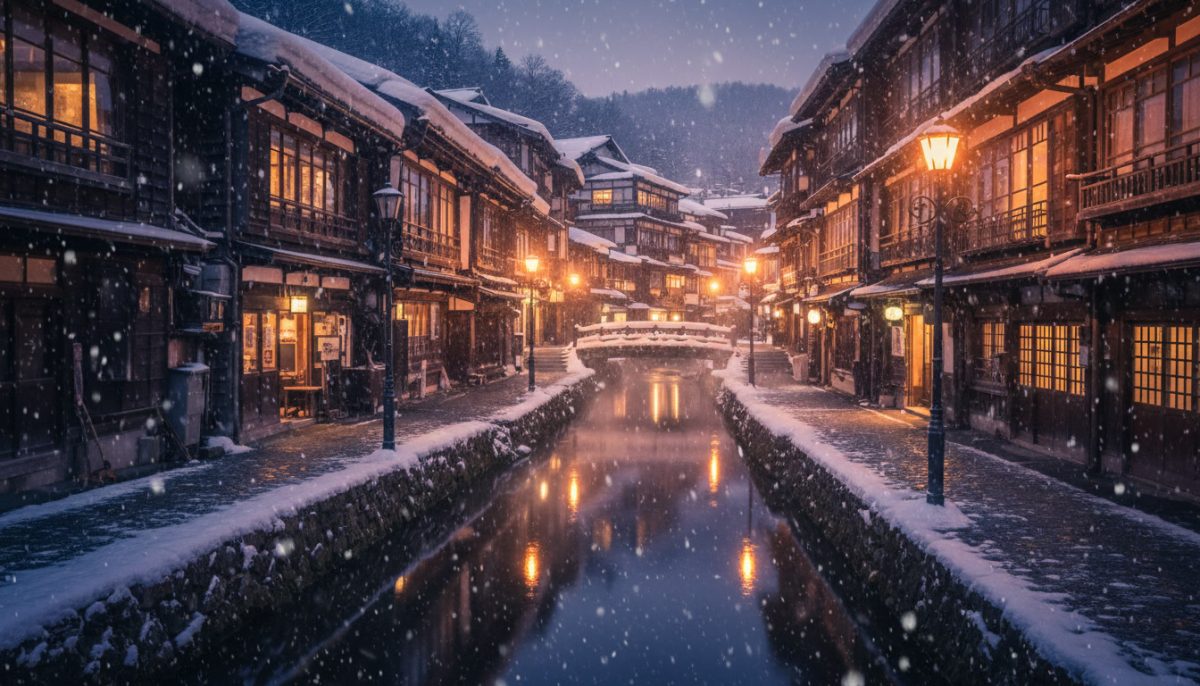
There is a narrow valley in Yamagata Prefecture where three- and four-story wooden ryokan line both sides of a small river. Gas lamps light the bridges at dusk. In winter, snow piles on the rooftops and balconies until the buildings look like illustrations from a book of fairy tales.
Ginzan Onsen (銀山温泉) is the most photographed onsen town in Japan for a reason: it does not look real. But it is — and staying here, especially at night, is one of the most atmospheric experiences available to a traveler in this country.
The Setting
Ginzan means “silver mountain.” The town grew around a silver mine that operated from the early 1600s until the mine’s closure in the late Meiji period. When the mine died, the town reinvented itself around its hot springs. The current ryokan buildings date mostly from the Taisho era (1912–1926), when Western architectural influences mixed with Japanese construction to produce the distinctive multi-story wooden facades that define the town today.
The entire town occupies a single valley no more than 300 meters long. The river runs down the center. There are no cars inside the town — only pedestrian bridges and stone pathways. At night, when the gas lamps come on and the windows of the ryokan glow warm against the snow, the scale of the place feels miniature, like a model village brought to life.
The Water
Ginzan’s spring water is sodium chloride and sulfate, clear, and slightly alkaline. It is gentle on the skin — none of the intensity of a sulfur or acidic spring. The temperature at the source is approximately 60°C, cooled to a comfortable 41–43°C in the baths.
Two public bathhouses are open to all visitors:
Shirogane-yu (しろがね湯): A modern building designed by architect Kuma Kengo, with a striking contemporary interior that contrasts with the Taisho-era surroundings. Admission is ¥500.
Omokagebashi Rotenburo: A small outdoor bath near the river, open seasonally.
Each ryokan also has its own private baths, and these are typically the best bathing experience — smaller, quieter, and available at all hours for overnight guests.
Where to Stay
Ginzan has roughly a dozen ryokan, all small (typically 10–20 rooms). Accommodation is almost exclusively ippaku nishoku (one night, two meals), and the meals are an integral part of the experience — mountain vegetables, river fish, Yamagata beef at higher-end inns, and local sake.
Budget: ¥12,000–¥18,000 per person per night Mid-range: ¥18,000–¥30,000 High-end: ¥30,000+
All prices include dinner and breakfast. Reservations are essential — Ginzan’s small capacity means that popular dates sell out quickly, particularly winter weekends and autumn foliage season.
Getting There
Ginzan is not easy to reach, and that is part of its charm.
From Tokyo: Yamagata Shinkansen to Oishida Station (approximately 3.5 hours). From Oishida, a local bus runs to Ginzan Onsen (approximately 40 minutes). The bus runs only a few times per day — check the schedule carefully.
By car: From Oishida Station, the drive is about 30 minutes. Parking is available at the edge of town (vehicles cannot enter the town itself). In winter, the mountain road requires snow tires.
Important: The last bus back to Oishida departs in the early afternoon. If you are visiting for a day trip (which is possible but not recommended), plan around this schedule.
When to Go
Winter (December–March): The definitive Ginzan experience. Heavy snow transforms the town into the scene that appears in every photograph. Temperatures drop well below freezing, and the contrast between cold air and warm bathwater is extraordinary.
Autumn (late October–early November): The surrounding mountains produce vivid foliage, and the town is beautiful without the logistical challenges of winter access.
Summer (July–August): Warm, green, quiet. The town looks entirely different — lush rather than stark — and visitor numbers are significantly lower.
What to Do (Besides Soak)
Ginzan is small enough that you can explore the entire town in an hour. But the point is not exploration — it is absorption.
Walk the old silver mine tunnels. A short trail at the upper end of the valley leads to the entrance of the abandoned mine, with interpretive signs explaining the town’s industrial history.
Eat tamago-konyaku at a street stall. A local snack — konjac jelly shaped like eggs — served warm from a pot. Simple, cheap, satisfying on a cold day.
Watch the gas lamps come on. Ginzan’s gas lamps are lit at dusk, and the transition from daylight to lamplight changes the entire atmosphere of the town. Find a spot on one of the bridges and watch it happen.
Do nothing. Ginzan rewards stillness. Sit in your ryokan room, look out the window at the snow, drink tea, and recognize that you have nowhere to be.
Practical Tips
- Book early. Three to six months in advance for winter. One to two months for other seasons.
- Cash. Most ryokan accept cash only. The nearest ATM is in Oishida.
- Shoes. Bring waterproof boots or shoes with good grip. The stone paths are beautiful but slippery when wet or icy.
- Photography at night. The town is gorgeous after dark, but shared bathing areas are strictly no-photography zones. Exterior shots of the buildings and bridges are fine and encouraged.
- Day trip vs. overnight. An overnight stay is dramatically better than a day trip. The town empties of day visitors by late afternoon, and the evening and early morning hours are when Ginzan is at its most magical.
FAQ
Is Ginzan Onsen crowded? During the day in peak season (winter weekends, autumn foliage), yes — day-trip visitors can make the narrow valley feel busy. But overnight guests have the town largely to themselves from late afternoon through morning.
Can I visit with tattoos? Policies vary by ryokan. The public bathhouses may restrict visible tattoos. Your best option is to ask your ryokan directly when booking, or use the in-room bath if available.
Is Ginzan worth visiting in summer? Yes, if you appreciate the architecture and atmosphere without the snow. The experience is quieter and more affordable, though visually very different from the iconic winter scenes.
Ginzan Onsen is featured in our regional guide and snow onsen guide. For first-time visitors, start with Onsen Etiquette: The Complete Guide.