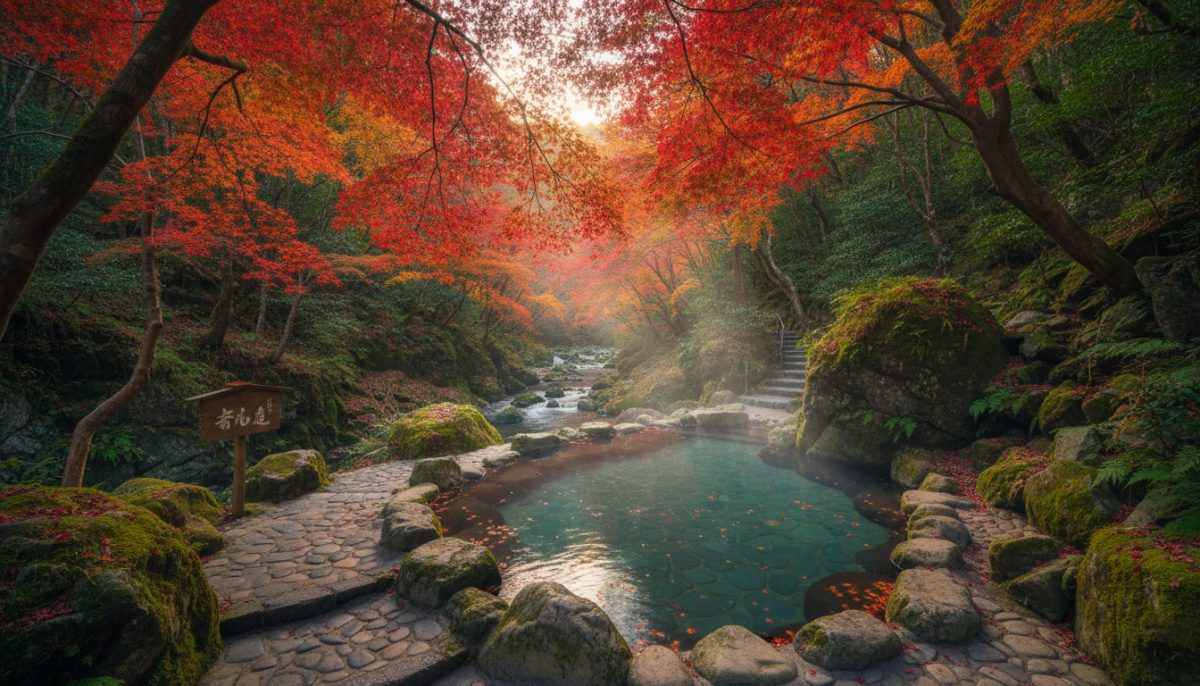


In the 1980s, Kurokawa Onsen was dying. The small town in a forested gorge in Kumamoto Prefecture had been losing visitors for years. The ryokan owners held a meeting and made a decision that would change the town’s future: instead of competing with bigger, flashier resort towns, they would go in the opposite direction.
They tore down garish signs. They planted trees. They agreed on building codes that kept everything low, wooden, and in harmony with the gorge. They created a shared bathing pass — the nyuyoku tegata — that encouraged visitors to walk between inns rather than staying locked in one.
Forty years later, Kurokawa is one of the most admired onsen towns in Japan. It is proof that restraint can be a competitive advantage.
The Nyuyoku Tegata (入湯手形)
Kurokawa’s signature innovation. For ¥1,300, you receive a small wooden plaque that grants access to any three of the town’s approximately thirty ryokan baths. You walk the gorge, choose whichever three appeal to you, present your tegata at the front desk, and bathe.
The pass is valid for six months, so you can spread your visits across multiple trips. The tegata itself — stamped with the name of each bath you visit — becomes a souvenir.
This system achieves something clever: it distributes visitors across the entire town rather than concentrating them at a few popular spots. Every inn benefits. Every visitor sees more of Kurokawa. The town functions as a single, distributed onsen experience rather than a collection of competing businesses.
The Water
Kurokawa’s springs are varied. Different inns draw from different sources, producing a range of water types:
| Water Type | Characteristics | Found At |
|---|---|---|
| Sulfur | Milky white, distinctive smell | Shinmeikan, Yamabiko Ryokan |
| Sodium chloride | Clear, warming, salty | Yamamizuki |
| Iron | Slightly brown, metallic | Kurokawa-so |
| Simple thermal | Clear, gentle | Multiple inns |
The variety makes the tegata pass worthwhile even from a purely sensory perspective. Three different baths can mean three distinctly different water experiences within a single afternoon.
The Town
Kurokawa occupies a narrow gorge along the Tanoharu River. The town is walkable in 30 minutes end to end, but the terrain is hilly — stairs and sloping paths connect the river level to the ryokan perched above.
What strikes most visitors first is what is absent: no neon signs, no vending machines lining the streets, no concrete buildings breaking the tree line. The aesthetic discipline is remarkable. Even the utility poles are hidden where possible. The result is a town that photographs well from every angle — not because it was designed for photographs, but because it was designed for coherence.
Small shops along the main path sell local crafts, sweets, and onsen cosmetics. A few cafes offer coffee and local desserts. But the town is not a shopping destination — it is a bathing destination that happens to have a few shops.
Where to Stay
All ryokan offer ippaku nishoku (one night, two meals). The quality of food across Kurokawa is consistently high — local river fish, Kumamoto beef, wild mountain vegetables, handmade tofu.
Budget-friendly: ¥10,000–¥15,000 per person per night Standard: ¥15,000–¥25,000 Premium (rooms with private bath): ¥25,000–¥45,000
The premium rooms with in-room rotenburo (outdoor private bath) are Kurokawa’s luxury offering and represent excellent value compared to similar rooms at better-known destinations like Hakone or Yufuin.
Getting There
From Kumamoto: Direct bus from Kumamoto Station to Kurokawa Onsen (approximately 3 hours). The Kyushu Odan bus runs several times daily.
From Fukuoka: Highway bus from Hakata Station to Kurokawa (approximately 3.5 hours with a transfer at Hita or direct seasonal services).
By car: The most flexible option. From Kumamoto, approximately 2 hours via the Yamanami Highway, one of Japan’s most scenic mountain driving routes. From Yufuin, approximately 1 hour — combining the two towns is a natural itinerary.
Tattoo Policy
Kurokawa is generally more tolerant of tattoos than many onsen towns. Several inns explicitly welcome tattooed guests, and the kashikiri (private bath) option is widely available. The town’s international reputation has pushed many ryokan to adopt flexible policies. However, confirming with your specific inn before booking is always advisable.
When to Go
Autumn (November): Peak season. The gorge fills with red and gold foliage, and the atmosphere is extraordinary. Book well in advance.
Winter (December–February): Kurokawa receives some snow, though less than Tohoku. The town illuminates bamboo structures along the river during the Yunohana Festival, creating a warm glow against the winter forest.
Summer (June–August): The gorge stays cool under tree cover. Fireflies appear along the river in late June. Visitor numbers are lower, and prices are more favorable.
Spring (March–April): Fresh green, mild temperatures, and a relaxed atmosphere before the autumn rush.
Practical Tips
- Buy the tegata at any ryokan front desk or at the tourist information center near the bus stop.
- Wear comfortable walking shoes. The paths between inns involve hills and stairs.
- Yukata walking is part of the culture here. Change into your ryokan’s yukata and geta (wooden sandals) before exploring the town.
- The gorge is beautiful at night. Several paths are subtly lit, and the sound of the river fills the silence.
- Combine with Yufuin or Beppu for a multi-day Kyushu onsen itinerary.
FAQ
Is Kurokawa Onsen worth the travel time? Yes. The remoteness is the reason the town looks the way it does. If it were easy to reach, it would have been developed differently — and it would not be Kurokawa.
Can I visit as a day trip? Technically yes — the tegata pass is designed for day visitors as well as overnight guests. But the evening atmosphere, when day visitors leave and the town quiets down, is a significant part of the experience.
Is there English-language support? Limited but growing. Some ryokan have English-speaking staff or English-language materials. The tourist information center can assist with basic inquiries. A translation app is helpful.
Kurokawa Onsen is featured in our regional guide and tattoo-friendly onsen guide. For cultural context, see Hitō, Toji, and the Quiet Art of Onsen.