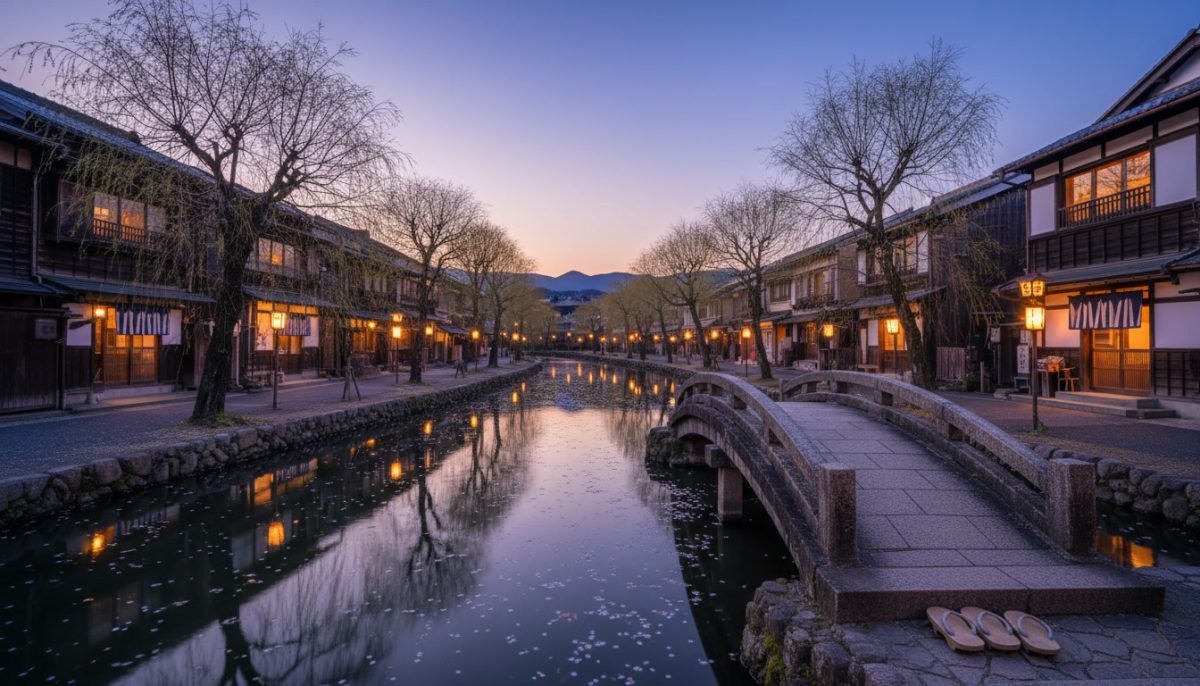


Most onsen towns ask you to choose one inn and stay put. Kinosaki asks you to leave your inn, put on a yukata and wooden sandals, and walk.
Kinosaki Onsen (城崎温泉) in Hyogo Prefecture is built around a single tradition: sotoyu meguri (外湯めぐり), the practice of strolling between public bathhouses and sampling them one by one. The town has seven, each with its own architecture and atmosphere. Your ryokan provides the yukata, the geta, and a pass that gets you into all of them.
The result is an onsen experience that is social, walkable, and surprisingly easy — even for someone who has never visited a Japanese hot spring before.
The Seven Sotoyu
Each bathhouse has a name, a distinct architectural style, and a traditional blessing associated with it.
Sato-no-Yu (さとの湯)
Nearest to the train station. The largest and most modern of the seven, with a rooftop open-air bath and a sauna. A practical first stop if you arrive by train and want to soak immediately.
Ichi-no-Yu (一の湯)
The symbolic center of Kinosaki. The building’s design evokes a kabuki theater, with a dramatic facade overlooking the main canal. The cave bath inside — carved from natural rock — is the most distinctive feature.
Gosho-no-Yu (御所の湯)
Designed to resemble the Kyoto Imperial Palace. The outdoor bath here is the largest in Kinosaki and offers views of the surrounding mountains. Recently renovated and consistently rated the most popular of the seven.
Mandara-Yu (まんだら湯)
The oldest bathhouse in Kinosaki, named after the Buddhist mandala. Small, traditional, and less crowded than Gosho-no-Yu or Ichi-no-Yu. A good choice for visitors who prefer a quieter atmosphere.
Jizo-Yu (地蔵湯)
A modern hexagonal building near the town center. Compact and efficient. The name refers to Jizo, the Buddhist guardian of travelers and children — an appropriate patron for a bathhouse in a tourist town.
Kouno-Yu (鴻の湯)
The most remote of the seven, at the far end of the canal. Named after the stork (konotori) that, according to legend, healed its wounds in the spring here. The outdoor bath is surrounded by garden greenery.
Yanagi-Yu (柳湯)
The smallest bathhouse. Named after the willow trees that line the canal beside it. The intimate scale makes it feel like a private bath, even though it is public.
How Sotoyu Meguri Works
When you check in to any ryokan in Kinosaki, you receive a yukata (cotton robe), geta (wooden sandals), and a sotoyu meguri pass — a QR-coded wristband or card that grants free entry to all seven bathhouses.
The tradition is simple:
- Change into your yukata at the ryokan
- Walk the canal and streets in your geta, listening to the distinctive clip-clop sound on the stone paths
- Enter a bathhouse, scan your pass, bathe
- Dry off, put your yukata back on, walk to the next one
- Stop for food or drinks between baths — soft-serve ice cream, crab croquettes, or local craft beer
Most visitors cover three to five bathhouses in an evening. Attempting all seven in one session is ambitious but achievable if you keep your soaks short.
Day visitors can purchase a day pass (¥1,500) at any bathhouse or at the tourist information center.
The Town Beyond the Baths
Kinosaki is compact enough to explore entirely on foot. The main canal — lined with willow trees and crossed by stone bridges — runs through the center of town. Cherry blossoms in spring, fireflies in early summer, and snow in winter each transform the same scenery.
Kinosaki Straw Craft Museum. The town has a centuries-old tradition of straw craft (mugiwara zaiku), producing intricate woven goods. The museum is small but genuinely interesting.
Onsenji Temple. A ropeway (cable car) climbs the mountain behind the town to Onsenji, the temple that has blessed Kinosaki’s waters for over a thousand years. The view from the top encompasses the town, the coast, and the Sea of Japan.
Crab season (November–March). Kinosaki is famous for matsuba-gani (snow crab), and winter menus at every ryokan feature crab in multiple preparations: sashimi, grilled, boiled, and in nabe hot pot. For many Japanese visitors, the crab is the primary reason to come.
Getting There
Kinosaki is one of the most accessible quality onsen towns in the Kansai region.
From Kyoto: JR limited express Kinosaki (approximately 2.5 hours direct). This is the most common route for international visitors.
From Osaka: JR limited express Kounotori (approximately 2.5–3 hours).
From Kobe: Similar to Osaka, approximately 2.5 hours via Fukuchiyama.
All routes are covered by the Japan Rail Pass, making Kinosaki an efficient addition to a Kansai itinerary.
Where to Stay
Kinosaki has over 80 ryokan ranging from budget-friendly guesthouses to luxury inns. Virtually all include the sotoyu meguri pass and serve dinner and breakfast.
Budget: ¥8,000–¥15,000 per person (modest rooms, standard meals) Standard: ¥15,000–¥25,000 (comfortable rooms, crab course in winter) Premium: ¥25,000–¥50,000+ (in-room bath, premium crab course, river-view rooms)
Tip: Winter rates are significantly higher due to crab season demand. Spring and summer offer the same sotoyu meguri experience at lower prices.
Why Kinosaki Works for First-Time Visitors
Kinosaki is the onsen town that THE Onsen Times recommends most often to travelers who have never visited a Japanese hot spring. The reasons are practical:
- The sotoyu meguri system removes decision paralysis. You do not need to research the “best” bath. Try all of them.
- The yukata tradition normalizes the experience. When everyone on the street is wearing a robe and wooden sandals, the social awkwardness of communal bathing disappears before you even reach the bathhouse.
- English-language support is strong. Kinosaki’s tourism office provides English maps and information. Many ryokan have English-speaking staff.
- Access is easy. Direct train from Kyoto with a Japan Rail Pass. No mountain roads, no transfers, no last buses to worry about.
FAQ
Can I visit Kinosaki as a day trip from Kyoto? Yes, and many visitors do. The round trip takes about 5 hours total, leaving enough time to visit two or three bathhouses and walk the town. However, an overnight stay is significantly better — the town is most atmospheric in the evening and early morning.
Are the bathhouses tattoo-friendly? Policies vary. Some of the seven bathhouses restrict visible tattoos. Your ryokan’s private bath is always an option. Contact the Kinosaki tourism office for current policies at specific bathhouses.
Is Kinosaki suitable for children? Yes. Japanese families bring children to Kinosaki regularly. The walking culture, the public bathhouses, and the crab restaurants are all family-oriented. Some ryokan offer family rooms and family bath options.
What is the best bathhouse of the seven? Gosho-no-Yu is consistently the most popular for its large outdoor bath and mountain views. Ichi-no-Yu is the most architecturally distinctive. Mandara-Yu is the best for a quiet soak. There is no wrong choice.
Kinosaki Onsen is featured in our regional guide. For first-time visitors, start with Onsen Etiquette: The Complete Guide.